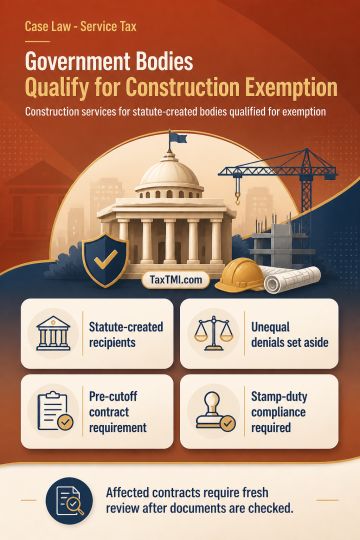
Governmental authority status supports construction-service exemption, while pre-cutoff contract and stamp-duty compliance requires verification on re...
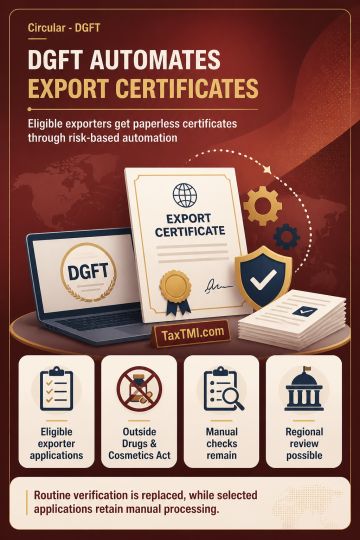
Automated Free Sale and Commerce Certificates enable paperless processing while retaining risk-based manual verification for selected exporter applica...
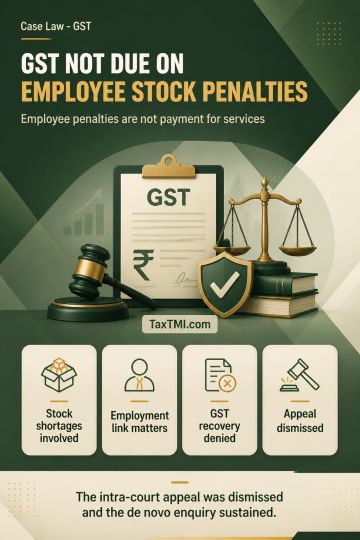
Employee stock-shortage penalties do not constitute consideration for services, preventing GST collection under Schedule II in employment relationship...
The CESTAT held that the appellant cannot be classified as an intermediary under Rule 2(f) of the Place of Provision of Services Rules, 2012, as the agency agreement with the holding company does not establish the appellant's role in arranging or facilitating a supply between two or more parties. The tribunal emphasized that mere contractual clauses stating the appellant acts on behalf of the holding company do not suffice without evidence of intermediary activity. The consideration on a cost-plus-fee basis further negates the intermediary characterization. Reliance on precedent confirmed that intermediary services require at least three parties with the intermediary facilitating the main supply between others, which is absent here. Consequently, the demand for service tax on this ground was unsustainable. Since the appeal succeeded on merits, the issue of extended limitation was not addressed. The impugned order was set aside and the appeal allowed.
The CESTAT held that the appellant cannot be classified as an intermediary under Rule 2(f) of the Place of Provision of Services Rules, 2012, as the agency agreement with the holding company does not establish the appellant's role in arranging or facilitating a supply between two or more parties. The tribunal emphasized that mere contractual clauses stating the appellant acts on behalf of the holding company do not suffice without evidence of intermediary activity. The consideration on a cost-plus-fee basis further negates the intermediary characterization. Reliance on precedent confirmed that intermediary services require at least three parties with the intermediary facilitating the main supply between others, which is absent here. Consequently, the demand for service tax on this ground was unsustainable. Since the appeal succeeded on merits, the issue of extended limitation was not addressed. The impugned order was set aside and the appeal allowed.
Note: It is a system-generated summary and is for quick reference only.
 TaxTMI
  TaxTMI
 of 4828




 Join Channel


