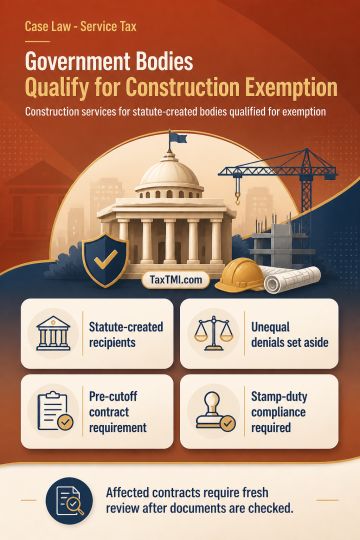
Governmental authority status supports construction-service exemption, while pre-cutoff contract and stamp-duty compliance requires verification on re...
Automated Free Sale and Commerce Certificates enable paperless processing while retaining risk-based manual verification for selected exporter applica...
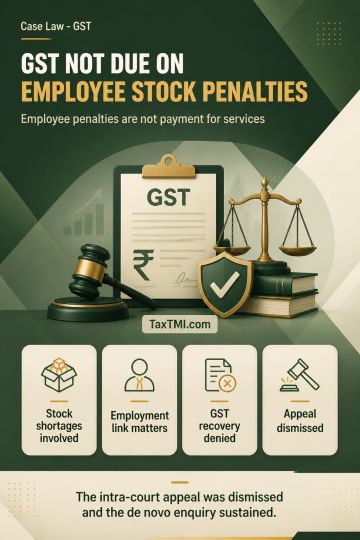
Employee stock-shortage penalties do not constitute consideration for services, preventing GST collection under Schedule II in employment relationship...
The ITAT held that revision under section 263 is not warranted where two reasonable views exist, one by the AO and another by the Pr. CIT. The AO's allowance of depreciation at 25% on the opening WDV plus capital expenditure in a BOT road project was upheld, supported by precedent. The Tribunal rejected the Pr. CIT's direction to exclude the negative grant of Rs. 595 crore payable to NHAI from the asset cost, affirming that under the mercantile system, accrued liabilities must be accounted for. The negative grant constituted an ascertained liability upon project completion in AY 2012-13, despite payment being due from the 15th year. The CBDT Circular No. 09/2014 was held inapplicable retrospectively to the assessment year in question. Consequently, the Pr. CIT's revision was quashed, and the assessee's claim for depreciation inclusive of the negative grant was restored, allowing the appeal.
The ITAT held that revision under section 263 is not warranted where two reasonable views exist, one by the AO and another by the Pr. CIT. The AO's allowance of depreciation at 25% on the opening WDV plus capital expenditure in a BOT road project was upheld, supported by precedent. The Tribunal rejected the Pr. CIT's direction to exclude the negative grant of Rs. 595 crore payable to NHAI from the asset cost, affirming that under the mercantile system, accrued liabilities must be accounted for. The negative grant constituted an ascertained liability upon project completion in AY 2012-13, despite payment being due from the 15th year. The CBDT Circular No. 09/2014 was held inapplicable retrospectively to the assessment year in question. Consequently, the Pr. CIT's revision was quashed, and the assessee's claim for depreciation inclusive of the negative grant was restored, allowing the appeal.
Note: It is a system-generated summary and is for quick reference only.
 TaxTMI
  TaxTMI
 of 4828










 Join Channel


