Retention of seized property survives where recorded reasons support proceeds of crime, while stayed investigation periods are excluded from limitatio...
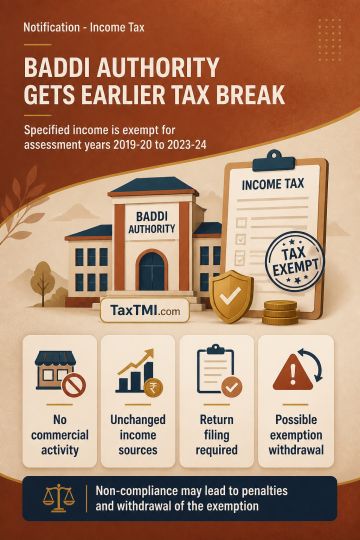
Specified income of Baddi Barotiwala Nalagarh Development Authority receives conditional tax exemption, retrospectively covering its designated assess...
Specified development authority income receives retrospective tax exemption, subject to non-commercial activity, unchanged income sources, and return-...
Unified Brand India framework introduces voluntary Trust Mark certification and funding support for export branding, packaging and global promotional ...
Origin Declaration authentication governs preferential tariff claims under India-UK CETA, requiring a validated reference number before import clearan...
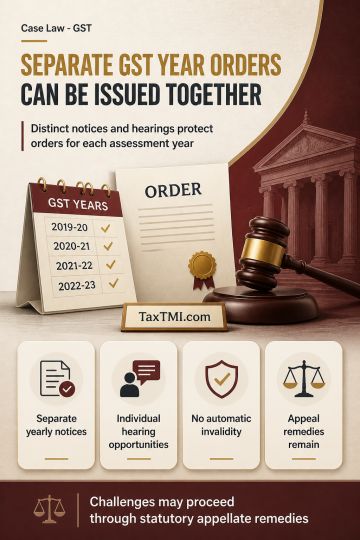
Separate assessment orders for different years remain valid when distinct notices and hearing opportunities prevent prejudice from combined proceeding...
The HC held that issuance of a single show cause notice encompassing multiple financial years contravenes the GST Act, which mandates that show cause notices must correspond to individual tax periods as defined under Section 2(106) and Sections 73/74. The Court emphasized that "bunching" violates principles of natural justice and statutory provisions, as each financial year constitutes a separate tax period. Furthermore, Section 128's provision for waiver schemes cannot justify pre-notification notices aggregating multiple years, as this imposes undue hardship on taxpayers. The Court clarified that show cause notices must be issued either based on annual returns after their filing or on monthly returns if issued prior to annual return submission. Accordingly, the petition challenging the validity of the multi-year show cause notice was allowed, reinforcing strict adherence to the statutory time limitation and procedural safeguards under the GST Act.
The HC held that issuance of a single show cause notice encompassing multiple financial years contravenes the GST Act, which mandates that show cause notices must correspond to individual tax periods as defined under Section 2(106) and Sections 73/74. The Court emphasized that "bunching" violates principles of natural justice and statutory provisions, as each financial year constitutes a separate tax period. Furthermore, Section 128's provision for waiver schemes cannot justify pre-notification notices aggregating multiple years, as this imposes undue hardship on taxpayers. The Court clarified that show cause notices must be issued either based on annual returns after their filing or on monthly returns if issued prior to annual return submission. Accordingly, the petition challenging the validity of the multi-year show cause notice was allowed, reinforcing strict adherence to the statutory time limitation and procedural safeguards under the GST Act.
Note: It is a system-generated summary and is for quick reference only.
 TaxTMI
 of 4805

















 Join Channel


 TaxTMI
