Opportunity to respond to jurisdictional reports is mandatory before customs settlement duty enhancement; connected applications require consistent ad...
Specific customs headings for scaffolding components prevail over general classification, invalidating misclassification proceedings and enabling with...
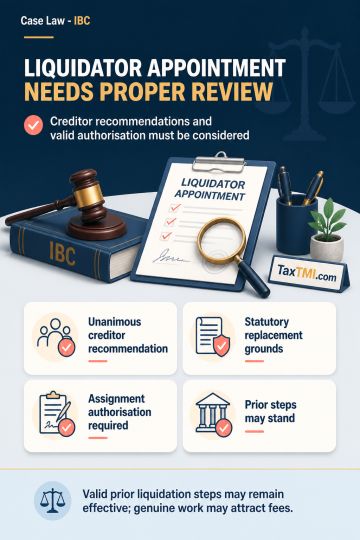
Liquidator appointment under Section 34 requires consideration of creditor recommendations, valid professional authorisation, and preservation of vali...
Income-tax exemption for specified regulatory fees and government grants applies subject to non-commercial activity and continuing compliance conditio...
Digital accessibility audit and remediation deadlines extended, while all other disability-compliance obligations for regulated entities remain unchan...
Page of 4803
Press 'Enter' after typing page number.
621 to 640 of 96047 Results
❮
❯
❯❯
0 / 200
Expand Note
Add to Folder
No Folders have been created
+
Are you sure you want to delete "My most important" ?
The HC held that issuance of a single show cause notice encompassing multiple financial years contravenes the GST Act, which mandates that show cause notices must correspond to individual tax periods as defined under Section 2(106) and Sections 73/74. The Court emphasized that "bunching" violates principles of natural justice and statutory provisions, as each financial year constitutes a separate tax period. Furthermore, Section 128's provision for waiver schemes cannot justify pre-notification notices aggregating multiple years, as this imposes undue hardship on taxpayers. The Court clarified that show cause notices must be issued either based on annual returns after their filing or on monthly returns if issued prior to annual return submission. Accordingly, the petition challenging the validity of the multi-year show cause notice was allowed, reinforcing strict adherence to the statutory time limitation and procedural safeguards under the GST Act.
The HC held that issuance of a single show cause notice encompassing multiple financial years contravenes the GST Act, which mandates that show cause notices must correspond to individual tax periods as defined under Section 2(106) and Sections 73/74. The Court emphasized that "bunching" violates principles of natural justice and statutory provisions, as each financial year constitutes a separate tax period. Furthermore, Section 128's provision for waiver schemes cannot justify pre-notification notices aggregating multiple years, as this imposes undue hardship on taxpayers. The Court clarified that show cause notices must be issued either based on annual returns after their filing or on monthly returns if issued prior to annual return submission. Accordingly, the petition challenging the validity of the multi-year show cause notice was allowed, reinforcing strict adherence to the statutory time limitation and procedural safeguards under the GST Act.
Note: It is a system-generated summary and is for quick reference only.
 TaxTMI
 of 4803
















 Join Channel


 TaxTMI