Transfer pricing and tax deductions upheld on established principles, while employee contributions and warranty provisions returned for fresh examinat...
Captive transfer pricing relies on industrial consumer tariffs, while genuine quotations can benchmark effluent treatment transfers under the Other Me...
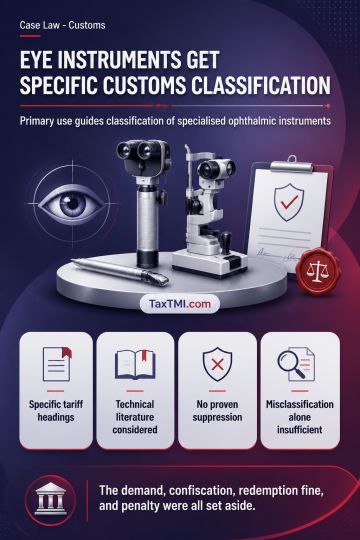
Specific tariff classification for ophthalmic instruments and extended limitation principles determine the treatment of duty demands, confiscation, an...
Integrated golf function determines classification, placing launch monitors and simulators under other golf equipment rather than measuring instrument...
Public servant status under anti-corruption law extends to recognised stock exchange leadership; constitutional and sanction challenges do not succeed...
Acquiescence, homebuyer protection and clean-slate resolution principles prevent landowners from disrupting an integrated project through late termina...
The ITAT upheld the ld.CIT(A)'s decision to treat the excess stock found during the survey as business income, dismissing the revenue's appeal. The AO failed to produce cogent evidence of income from sources other than the jewellery business. The tribunal accepted the assessee's explanation regarding the separate ledger for old gold purchases, increasing the book stock and reducing the excess stock to 11,390.212 grams. The addition was restricted accordingly. Regarding valuation, the tribunal rejected the AO and ld.CIT(A)'s higher rate of Rs. 2,800 per gram and the assessee's lower rate of Rs. 2,296 per gram, adopting Rs. 2,409 per gram as agreed by the assessee in correspondence, to compute income from excess stock. This approach balanced the competing valuations and concluded the matter.
The ITAT upheld the ld.CIT(A)'s decision to treat the excess stock found during the survey as business income, dismissing the revenue's appeal. The AO failed to produce cogent evidence of income from sources other than the jewellery business. The tribunal accepted the assessee's explanation regarding the separate ledger for old gold purchases, increasing the book stock and reducing the excess stock to 11,390.212 grams. The addition was restricted accordingly. Regarding valuation, the tribunal rejected the AO and ld.CIT(A)'s higher rate of Rs. 2,800 per gram and the assessee's lower rate of Rs. 2,296 per gram, adopting Rs. 2,409 per gram as agreed by the assessee in correspondence, to compute income from excess stock. This approach balanced the competing valuations and concluded the matter.
Note: It is a system-generated summary and is for quick reference only.
 TaxTMI
 of 4805

















 Join Channel


 TaxTMI