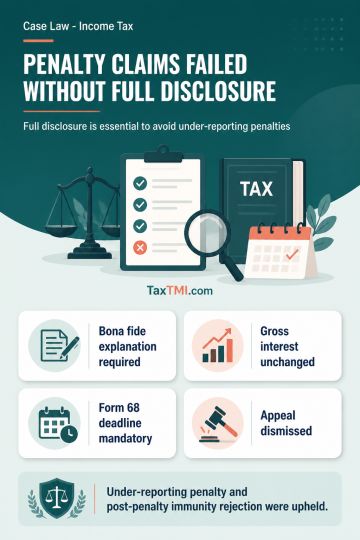
Bona fide disclosure requirements govern under-reporting penalties, and post-penalty immunity applications cannot secure available statutory protectio...
Certificate-of-origin verification procedure governs preferential customs benefits; denial without retroactive verification was set aside with consequ...
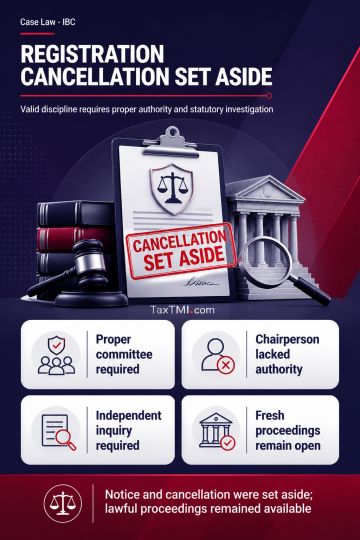
Disciplinary Committee jurisdiction and mandatory investigation requirements invalidated cancellation of an insolvency professional's registration and...
Retention of seized property survives where recorded reasons support proceeds of crime, while stayed investigation periods are excluded from limitatio...
Specified income of Baddi Barotiwala Nalagarh Development Authority receives conditional tax exemption, retrospectively covering its designated assess...
Page of 4805
Press 'Enter' after typing page number.
1221 to 1240 of 96092 Results
❮
❯
❯❯
0 / 200
Expand Note
Add to Folder
No Folders have been created
+
Are you sure you want to delete "My most important" ?
The ITAT upheld the order of the CIT(A) deleting the addition made by the AO under section 13(1)(c) read with sections 13(2)(c), 13(2)(g), and 13(2)(h) of the Act, and invoked section 40A(2)(a) for alleged excessive payments to related parties. The appellant society, operating numerous educational institutions, had entered into service contracts with related companies. The AO disallowed payments as excessive without adducing comparable third-party service evidence or industrial benchmarks. The Tribunal held that mere related-party transactions do not ipso facto render payments excessive; the AO's adhoc disallowance was based on suspicion and lacked evidentiary basis. The payments were found commensurate with services rendered. Consequently, the appeal by the Revenue was dismissed, affirming the deletion of additions and denial of exemption under section 11, as the appellant complied with the statutory parameters regarding related-party service payments.
The ITAT upheld the order of the CIT(A) deleting the addition made by the AO under section 13(1)(c) read with sections 13(2)(c), 13(2)(g), and 13(2)(h) of the Act, and invoked section 40A(2)(a) for alleged excessive payments to related parties. The appellant society, operating numerous educational institutions, had entered into service contracts with related companies. The AO disallowed payments as excessive without adducing comparable third-party service evidence or industrial benchmarks. The Tribunal held that mere related-party transactions do not ipso facto render payments excessive; the AO's adhoc disallowance was based on suspicion and lacked evidentiary basis. The payments were found commensurate with services rendered. Consequently, the appeal by the Revenue was dismissed, affirming the deletion of additions and denial of exemption under section 11, as the appellant complied with the statutory parameters regarding related-party service payments.
Note: It is a system-generated summary and is for quick reference only.
 TaxTMI
 of 4805












 Join Channel


 TaxTMI

