Necessary-party requirements limit impleadment of independent entities, while deferred consideration does not create an appealable adverse determinati...
Food supplement classification requires common parlance and authoritative tests, preventing treatment as proprietary Ayurvedic medicines without suppo...
Specified regulatory authority income receives conditional tax exemption, subject to non-commercial activity, unchanged income character, and return f...
Tax exemption for regulatory authority income applies retrospectively, subject to non-commercial activity, unchanged income sources, and return-filing...
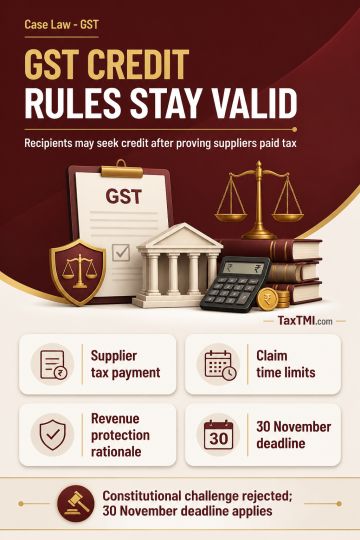
Input tax credit conditions remain constitutionally valid, with eligible recipient claims considered under GST circulars and retrospective filing dead...
The HC declined to exercise extraordinary jurisdiction under Article 226, holding that the petition challenging an ex facie jurisdictional order is not maintainable in the absence of pleadings justifying waiver of the pre-deposit requirement. The court emphasized that the statutory regime, including pre-deposit, must be adhered to and alternative remedies must be exhausted before invoking writ jurisdiction. Reliance on precedents confirmed that the petitioner failed to demonstrate any exceptional circumstances warranting interference. Consequently, the petition was dismissed, and the petitioner was directed to pursue the efficacious alternate remedy available under the statutory framework. This decision underscores the principle that writ jurisdiction is not a substitute for statutory remedies, especially where the impugned order is passed without jurisdiction and time limitations are applicable.
The HC declined to exercise extraordinary jurisdiction under Article 226, holding that the petition challenging an ex facie jurisdictional order is not maintainable in the absence of pleadings justifying waiver of the pre-deposit requirement. The court emphasized that the statutory regime, including pre-deposit, must be adhered to and alternative remedies must be exhausted before invoking writ jurisdiction. Reliance on precedents confirmed that the petitioner failed to demonstrate any exceptional circumstances warranting interference. Consequently, the petition was dismissed, and the petitioner was directed to pursue the efficacious alternate remedy available under the statutory framework. This decision underscores the principle that writ jurisdiction is not a substitute for statutory remedies, especially where the impugned order is passed without jurisdiction and time limitations are applicable.
Note: It is a system-generated summary and is for quick reference only.
 TaxTMI
 of 4792

















 Join Channel


 TaxTMI