Business expenditure deduction requires proof of genuine commission payments and commercial allowability; turnover growth alone cannot validate the cl...
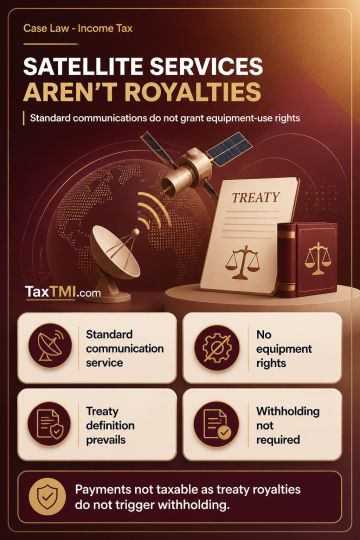
Article 8 treaty coverage excluded third-party airline support services, while documented demonetisation cash receipts remained accepted business inco...
Functional comparability under TNMM requires highway contract benchmarks to reflect operation, maintenance and transfer activities, requiring fresh be...
Objective characteristics govern magnesium bis-glycinate chelate classification as an amino-acid coordination compound, not a food preparation or anti...
Page of 4803
Press 'Enter' after typing page number.
581 to 600 of 96046 Results
❮
❯
❯❯
0 / 200
Expand Note
Add to Folder
No Folders have been created
+
Are you sure you want to delete "My most important" ?
The HC dismissed the writ petition challenging the denial of Input Tax Credit (ITC) where the petitioner was found to have availed inadmissible credit based on fictitious invoices issued by non-existent suppliers. The Court held that no Show Cause Notice or personal hearing violated natural justice principles, but the writ petition was not maintainable due to the fraudulent nature of the ITC claim, aligning with precedent restricting writ relief in such cases to protect the exchequer and GST regime. The limitation argument was rejected as the impugned order was validly passed within the prescribed period. The petitioner was granted leave to file an appeal before the Appellate Authority within one month, subject to the required pre-deposit.
The HC dismissed the writ petition challenging the denial of Input Tax Credit (ITC) where the petitioner was found to have availed inadmissible credit based on fictitious invoices issued by non-existent suppliers. The Court held that no Show Cause Notice or personal hearing violated natural justice principles, but the writ petition was not maintainable due to the fraudulent nature of the ITC claim, aligning with precedent restricting writ relief in such cases to protect the exchequer and GST regime. The limitation argument was rejected as the impugned order was validly passed within the prescribed period. The petitioner was granted leave to file an appeal before the Appellate Authority within one month, subject to the required pre-deposit.
Note: It is a system-generated summary and is for quick reference only.
 TaxTMI
 of 4803















 Join Channel


 TaxTMI