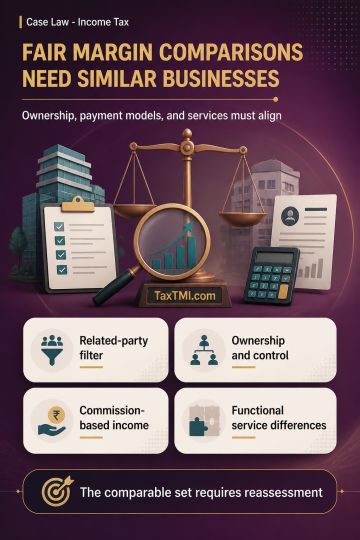
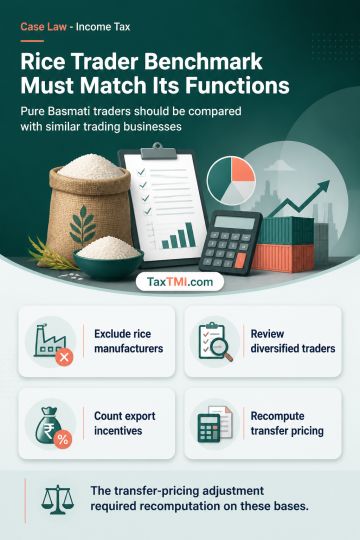
TNMM functional comparability requires excluding rice manufacturers from a pure Basmati rice trader's benchmark and recognising operating export recei...
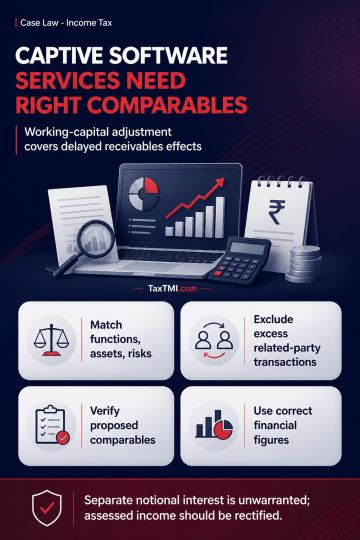
Working-capital adjustment subsumes delayed-receivable effects in TNMM benchmarking of captive software-development services, avoiding separate notion...
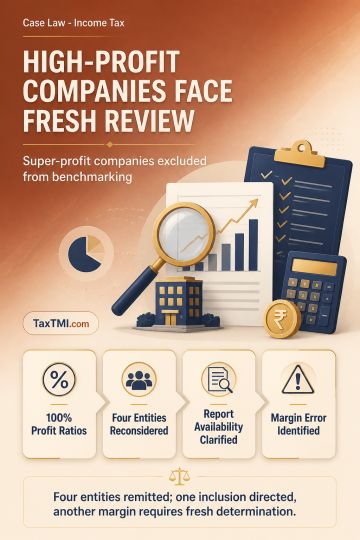
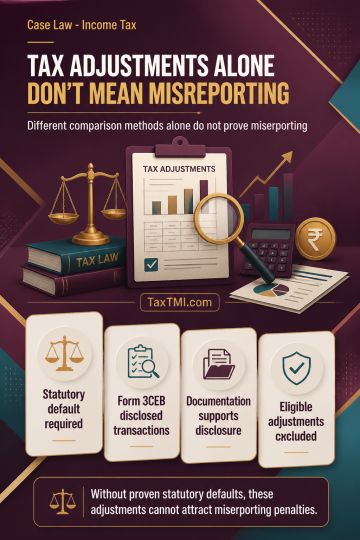
Transfer-pricing comparability requires exclusion of financially illogical super-profit comparables and correction of unsupported annual-report and ma...
Charitable character assessment preserves Section 80G approval despite inclusive spiritual teachings and incidental religious expenditure within the s...
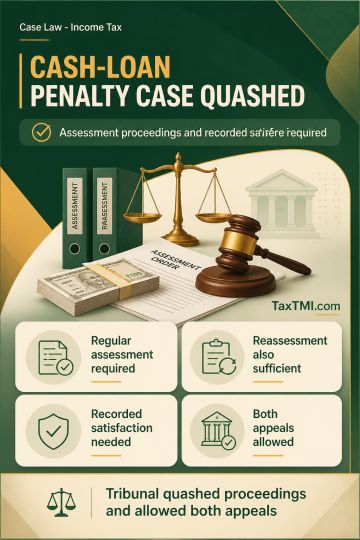
Penalty proceedings for cash-loan acceptance require assessment proceedings and recorded Assessing Officer satisfaction; absent these, the proceedings...
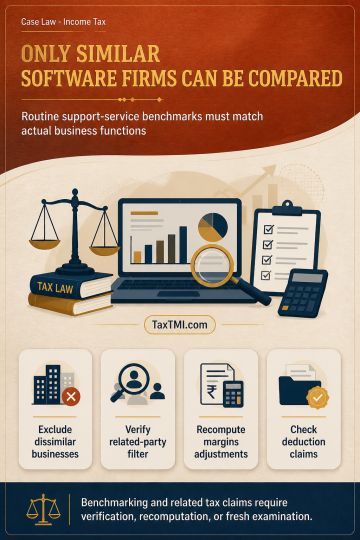
Functional comparability governs software-service benchmarking: dissimilar companies are excluded, while related-party filters, margins and working-ca...
The ITAT upheld the CIT(A)'s exclusion of certain companies as functionally dissimilar for transfer pricing comparability analysis, confirming their unsuitability as comparable entities for ALP determination. The Tribunal accepted the turnover filter applied by the CIT(A), recognizing that despite service industry norms, turnover impacts profitability due to intangibles like brand value, justifying a turnover cap of up to ten times that of the assessee. Consequently, the inclusion of specified companies with turnover within the prescribed range was affirmed for benchmarking the international transactions. The Tribunal's decision validates the CIT(A)'s methodology and findings on comparable selection and turnover criteria, directing adherence to the adjusted comparable set and turnover limits for ALP computation.
The ITAT upheld the CIT(A)'s exclusion of certain companies as functionally dissimilar for transfer pricing comparability analysis, confirming their unsuitability as comparable entities for ALP determination. The Tribunal accepted the turnover filter applied by the CIT(A), recognizing that despite service industry norms, turnover impacts profitability due to intangibles like brand value, justifying a turnover cap of up to ten times that of the assessee. Consequently, the inclusion of specified companies with turnover within the prescribed range was affirmed for benchmarking the international transactions. The Tribunal's decision validates the CIT(A)'s methodology and findings on comparable selection and turnover criteria, directing adherence to the adjusted comparable set and turnover limits for ALP computation.
Note: It is a system-generated summary and is for quick reference only.
 TaxTMI
  TaxTMI
 of 4830









 Join Channel


