Governmental authority status supports construction-service exemption, while pre-cutoff contract and stamp-duty compliance requires verification on re...
Automated Free Sale and Commerce Certificates enable paperless processing while retaining risk-based manual verification for selected exporter applica...
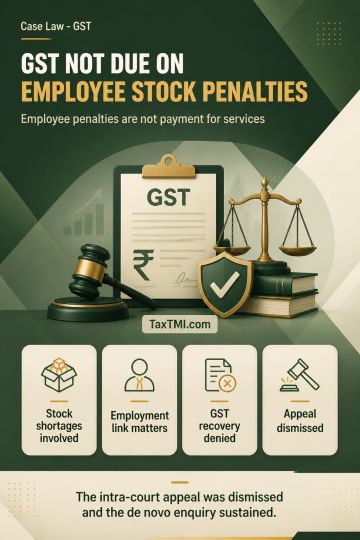
Employee stock-shortage penalties do not constitute consideration for services, preventing GST collection under Schedule II in employment relationship...
The CESTAT held that the appellant did not suppress facts with intent to evade central excise duty, as records were properly maintained, VAT compliance was followed, and transactions were transparent. Although the appellant crossed the Rs. 1.5 crore threshold for excise duty liability based on MRP less abatement, the extended period of limitation for recovery could not be invoked due to lack of intent to evade duty. Allegations of clandestine clearance were unsubstantiated. The demand confirmed under extended limitation was unsustainable, and since the appellant did not dispute duty liability before the Commissioner (Appeals), the Tribunal limited its consideration to penalties. Penalties imposed on the appellant firm were set aside due to bona fide belief and proper record-keeping. Penalty on the proprietor was also quashed to avoid double jeopardy, as the firm and proprietor are one entity. The appeal was allowed and penalties were set aside.
The CESTAT held that the appellant did not suppress facts with intent to evade central excise duty, as records were properly maintained, VAT compliance was followed, and transactions were transparent. Although the appellant crossed the Rs. 1.5 crore threshold for excise duty liability based on MRP less abatement, the extended period of limitation for recovery could not be invoked due to lack of intent to evade duty. Allegations of clandestine clearance were unsubstantiated. The demand confirmed under extended limitation was unsustainable, and since the appellant did not dispute duty liability before the Commissioner (Appeals), the Tribunal limited its consideration to penalties. Penalties imposed on the appellant firm were set aside due to bona fide belief and proper record-keeping. Penalty on the proprietor was also quashed to avoid double jeopardy, as the firm and proprietor are one entity. The appeal was allowed and penalties were set aside.
Note: It is a system-generated summary and is for quick reference only.
 TaxTMI
  TaxTMI
 of 4828














 Join Channel


