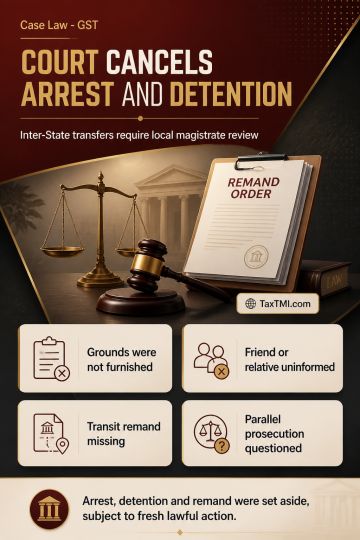
Arrest safeguards and transit remand requirements invalidated detention following inter-State transfer without communicated grounds or magistrate auth...
Arrest safeguards require disclosed grounds, relative intimation and transit remand, while duplicate prosecution under the CGST framework is unsustain...
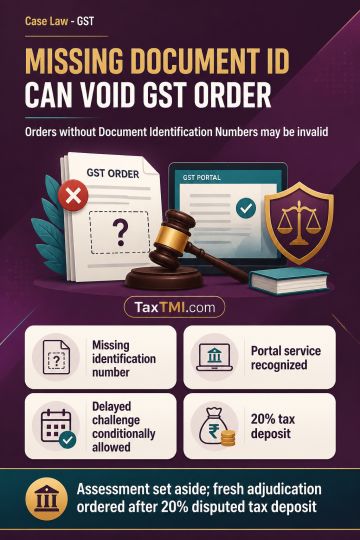
Document Identification Number defects can invalidate GST assessments, with delayed challenges entertained conditionally where patent irregularities e...
Windmill commissioning evidence supported higher depreciation where grid connection and electricity generation proved operational use before the relev...
Pharmaceutical promotion and transfer-pricing comparability principles limited disallowances, while uncorroborated search allegations and unsupported ...
Page of 4796
Press 'Enter' after typing page number.
661 to 680 of 95918 Results
❮
❯
❯❯
0 / 200
Expand Note
Add to Folder
No Folders have been created
+
Are you sure you want to delete "My most important" ?
The HC upheld the penalty order under Section 129 of the GST Act, 2017, rejecting the challenge to the detention of goods unloaded at a place not registered under the petitioner's GST registration. The court emphasized the overriding effect of Section 129's non obstante clause, mandating strict compliance. The petitioner attempted to amend its registration post-detention by adding an additional place of business via affidavit, which the court found was a belated effort to circumvent statutory consequences. The amendment was not filed prior to the goods being in transit, and thus could not absolve liability. Consequently, the petition was dismissed, affirming the imposition of penalties for contravention of Section 129 due to unloading at an unregistered place.
The HC upheld the penalty order under Section 129 of the GST Act, 2017, rejecting the challenge to the detention of goods unloaded at a place not registered under the petitioner's GST registration. The court emphasized the overriding effect of Section 129's non obstante clause, mandating strict compliance. The petitioner attempted to amend its registration post-detention by adding an additional place of business via affidavit, which the court found was a belated effort to circumvent statutory consequences. The amendment was not filed prior to the goods being in transit, and thus could not absolve liability. Consequently, the petition was dismissed, affirming the imposition of penalties for contravention of Section 129 due to unloading at an unregistered place.
Note: It is a system-generated summary and is for quick reference only.
 TaxTMI
 of 4796












 Join Channel


 TaxTMI