Development agreements require legal possession or effective enjoyment for capital gains transfer; permissive possession and deferred consideration de...
Prolonged sterilisation of development rights supports capital-gains treatment, while business-income disallowances cannot govern capital-gains comput...
Additional evidence in transfer pricing dispute leads to fresh examination, while tax deductions, TDS credit, fee and refund interest require verifica...
Category II AIF pass-through taxation preserves non-business income character; investment receipts cannot be reclassified without applying recognised ...
Mutual fund maturity rules require proper rollover, redemption, disclosure, and due diligence; investor gains cannot excuse regulatory breaches or pen...
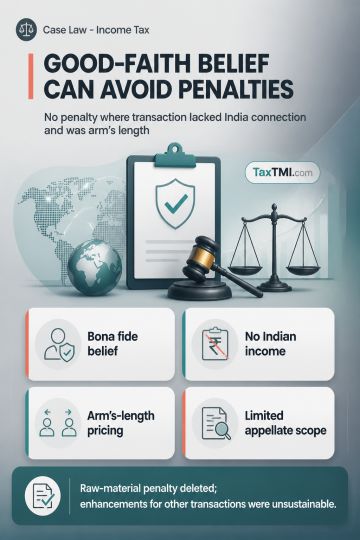
The ITAT upheld the deletion of penalty under section 271(1)(c) imposed on the assessee for disallowance of business loss claims related to advances treated as capital investments and interest expenditure disallowance. The Tribunal held that the assessee fully disclosed all relevant facts and there was no concealment or deliberate misstatement of income particulars. The dispute concerned a legal interpretation of transaction nature, not furnishing inaccurate particulars. Reliance was placed on precedents establishing that mere unsustainable claims do not attract penalty absent mala fide intent or concealment. The AO failed to demonstrate any intention to mislead or suppress material facts. As two views were possible on the allowability of the claims, the penalty was correctly deleted by the CIT(A). The appeal by the assessee was thus allowed.
The ITAT upheld the deletion of penalty under section 271(1)(c) imposed on the assessee for disallowance of business loss claims related to advances treated as capital investments and interest expenditure disallowance. The Tribunal held that the assessee fully disclosed all relevant facts and there was no concealment or deliberate misstatement of income particulars. The dispute concerned a legal interpretation of transaction nature, not furnishing inaccurate particulars. Reliance was placed on precedents establishing that mere unsustainable claims do not attract penalty absent mala fide intent or concealment. The AO failed to demonstrate any intention to mislead or suppress material facts. As two views were possible on the allowability of the claims, the penalty was correctly deleted by the CIT(A). The appeal by the assessee was thus allowed.
Note: It is a system-generated summary and is for quick reference only.
 TaxTMI
 of 4796




















 Join Channel


 TaxTMI