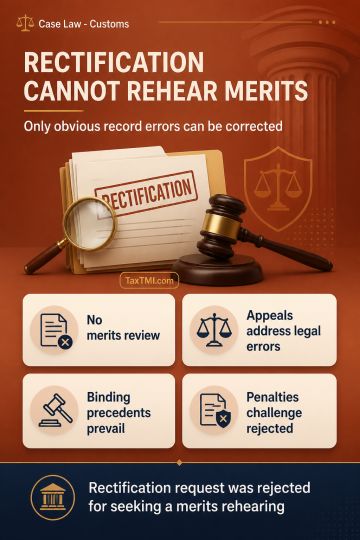
Rectification of mistake remains limited to self-evident record errors, preventing merits review through miscellaneous applications and preserving fin...
Tender creditworthiness conditions may extend to de facto Promoter Directors, with post-participation challenges generally barred absent arbitrariness...
Corporate representation in PMLA summons proceedings permitted through an authorised signatory, subject to directors' continuing cooperation and atten...
Helicopter charter classification requires effective control analysis, while territorial performance, reasoned credit orders and wilful suppression de...
Specified fund definition expands PAN exemption eligibility for registered alternative investment funds and qualifying International Financial Service...
Tax exemption for specified legal-services authority income applies retrospectively, subject to non-commercial activity, unchanged income sources, and...
The ITAT upheld the deletion of penalty under section 271(1)(c) imposed on the assessee for disallowance of business loss claims related to advances treated as capital investments and interest expenditure disallowance. The Tribunal held that the assessee fully disclosed all relevant facts and there was no concealment or deliberate misstatement of income particulars. The dispute concerned a legal interpretation of transaction nature, not furnishing inaccurate particulars. Reliance was placed on precedents establishing that mere unsustainable claims do not attract penalty absent mala fide intent or concealment. The AO failed to demonstrate any intention to mislead or suppress material facts. As two views were possible on the allowability of the claims, the penalty was correctly deleted by the CIT(A). The appeal by the assessee was thus allowed.
The ITAT upheld the deletion of penalty under section 271(1)(c) imposed on the assessee for disallowance of business loss claims related to advances treated as capital investments and interest expenditure disallowance. The Tribunal held that the assessee fully disclosed all relevant facts and there was no concealment or deliberate misstatement of income particulars. The dispute concerned a legal interpretation of transaction nature, not furnishing inaccurate particulars. Reliance was placed on precedents establishing that mere unsustainable claims do not attract penalty absent mala fide intent or concealment. The AO failed to demonstrate any intention to mislead or suppress material facts. As two views were possible on the allowability of the claims, the penalty was correctly deleted by the CIT(A). The appeal by the assessee was thus allowed.
Note: It is a system-generated summary and is for quick reference only.
 TaxTMI
 of 4788


















 Join Channel


 TaxTMI