Commercial vehicle depreciation, scientifically determined warranty provisions and exempt-income disallowances were resolved in favour of the taxpayer...
Inherited property sale proceeds require capital-gains treatment where ownership is supported by evidence, not suspicion or unverified signature doubt...
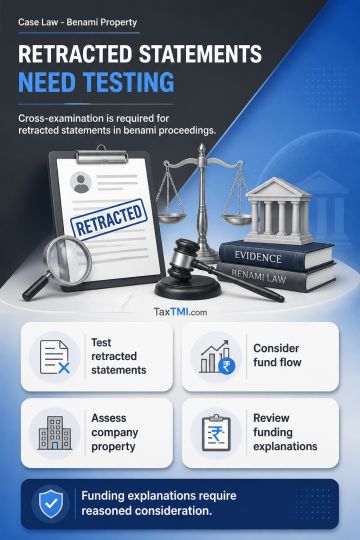
Cross-examination of retracted statements is essential where foundational evidence supports a benami allegation and documented funding explanations re...
Capital-goods exemption covers plant-modernisation accessories, while the import restriction applies only to earlier capital-goods components and spar...
Constitutional judicial review permits challenges to ECIRs and connected money-laundering proceedings where coercive action affects fundamental intere...
The ITAT upheld the deletion of penalty under section 271(1)(c) imposed on the assessee for disallowance of business loss claims related to advances treated as capital investments and interest expenditure disallowance. The Tribunal held that the assessee fully disclosed all relevant facts and there was no concealment or deliberate misstatement of income particulars. The dispute concerned a legal interpretation of transaction nature, not furnishing inaccurate particulars. Reliance was placed on precedents establishing that mere unsustainable claims do not attract penalty absent mala fide intent or concealment. The AO failed to demonstrate any intention to mislead or suppress material facts. As two views were possible on the allowability of the claims, the penalty was correctly deleted by the CIT(A). The appeal by the assessee was thus allowed.
The ITAT upheld the deletion of penalty under section 271(1)(c) imposed on the assessee for disallowance of business loss claims related to advances treated as capital investments and interest expenditure disallowance. The Tribunal held that the assessee fully disclosed all relevant facts and there was no concealment or deliberate misstatement of income particulars. The dispute concerned a legal interpretation of transaction nature, not furnishing inaccurate particulars. Reliance was placed on precedents establishing that mere unsustainable claims do not attract penalty absent mala fide intent or concealment. The AO failed to demonstrate any intention to mislead or suppress material facts. As two views were possible on the allowability of the claims, the penalty was correctly deleted by the CIT(A). The appeal by the assessee was thus allowed.
Note: It is a system-generated summary and is for quick reference only.
 TaxTMI
 of 4780




















 Join Channel


 TaxTMI
