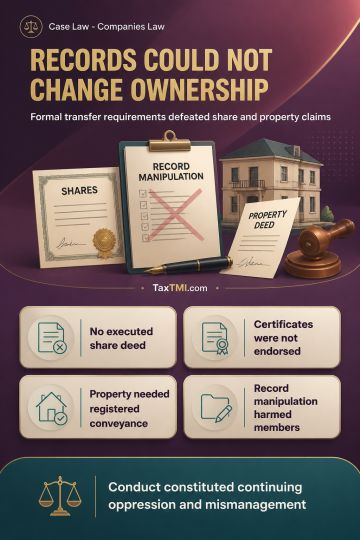
Statutory transfer formalities invalidated alleged share and property transfers, while retrospective record manipulation constituted oppression and mi...
Provisional attachment of laundered funds and equivalent-value property sustained, with statutory protection limited to pension, gratuity and providen...
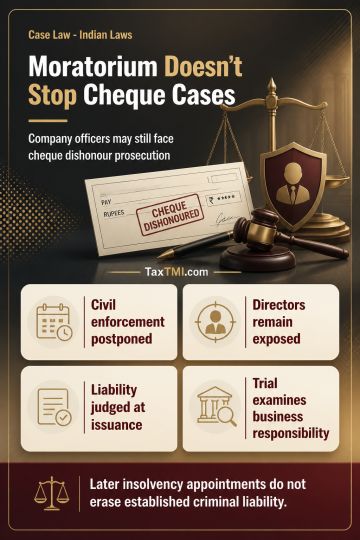
Insolvency moratorium does not shield company officers from cheque dishonour prosecution for liability arising before corporate insolvency proceedings...
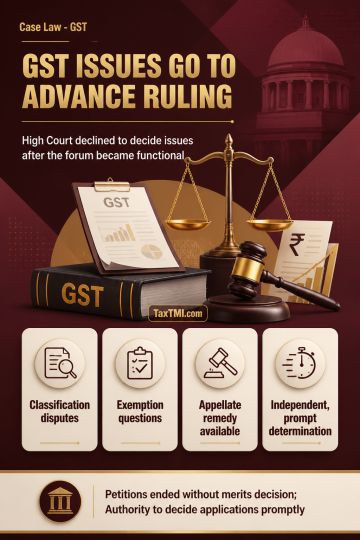
Advance-ruling mechanism governs pending GST classification, exemption and taxability disputes, limiting writ review once the specialised forum functi...
Page of 4788
Press 'Enter' after typing page number.
581 to 600 of 95752 Results
❮
❯
❯❯
0 / 200
Expand Note
Add to Folder
No Folders have been created
+
Are you sure you want to delete "My most important" ?
The ITAT held that the notice issued under section 153C for AY 2015-16 was barred by limitation, as the limitation period must be reckoned from the date of recording the satisfaction note (10.06.2021) and not the date of search (20.07.2018). Consequently, proceedings for AY 2015-16 were without jurisdiction and liable to be quashed. Further, the tribunal found the satisfaction note to be cryptic and lacking tangible, descriptive information, failing to demonstrate proper application of mind by the AO. This legal infirmity rendered the assumption of jurisdiction under section 153C invalid. The AO's failure to specify documents or assets pertaining to each assessment year in the consolidated satisfaction note vitiated the notice and assessment order. Accordingly, the appeal was allowed, and the proceedings and assessment under section 153C were quashed as null and void.
The ITAT held that the notice issued under section 153C for AY 2015-16 was barred by limitation, as the limitation period must be reckoned from the date of recording the satisfaction note (10.06.2021) and not the date of search (20.07.2018). Consequently, proceedings for AY 2015-16 were without jurisdiction and liable to be quashed. Further, the tribunal found the satisfaction note to be cryptic and lacking tangible, descriptive information, failing to demonstrate proper application of mind by the AO. This legal infirmity rendered the assumption of jurisdiction under section 153C invalid. The AO's failure to specify documents or assets pertaining to each assessment year in the consolidated satisfaction note vitiated the notice and assessment order. Accordingly, the appeal was allowed, and the proceedings and assessment under section 153C were quashed as null and void.
Note: It is a system-generated summary and is for quick reference only.
 TaxTMI
 of 4788











 Join Channel


 TaxTMI