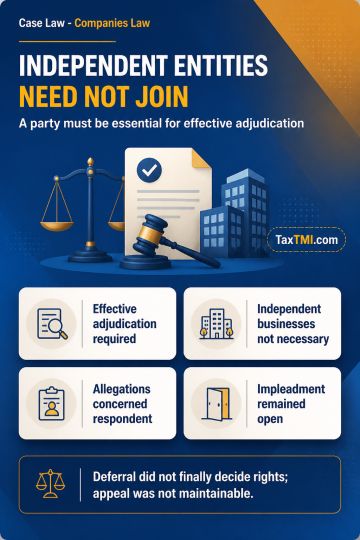
Necessary-party requirements limit impleadment of independent entities, while deferred consideration does not create an appealable adverse determinati...
Food supplement classification requires common parlance and authoritative tests, preventing treatment as proprietary Ayurvedic medicines without suppo...
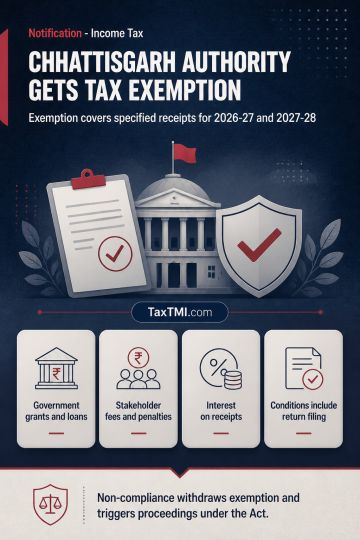
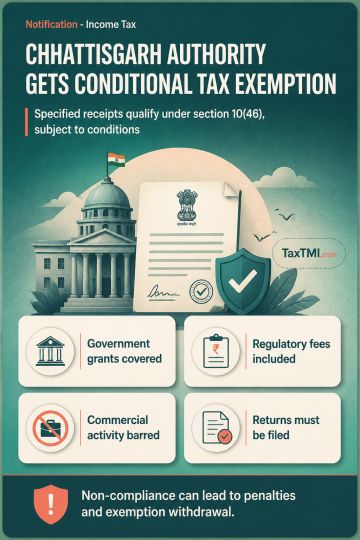
Specified regulatory authority income receives conditional tax exemption, subject to non-commercial activity, unchanged income character, and return f...
Tax exemption for regulatory authority income applies retrospectively, subject to non-commercial activity, unchanged income sources, and return-filing...
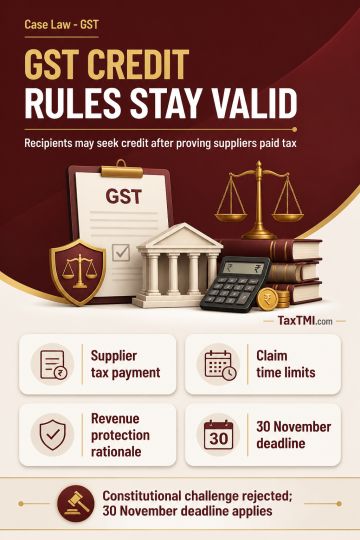
Input tax credit conditions remain constitutionally valid, with eligible recipient claims considered under GST circulars and retrospective filing dead...
The CESTAT held that the appellant's training programme, approved by the Ministry of Skill Development & Entrepreneurship and conducted as a partner of the National Skill Development Corporation, qualifies for exemption from service tax under Sl. No. 9A of Notification No. 25/2012-ST. The Tribunal found the programme falls within the scope of approved vocational education courses eligible for exemption under Section 66D(1)(iii) of the Finance Act, 1994, rendering further discussion on this ground unnecessary. Regarding limitation, the Department's prior knowledge and acknowledgement of the appellant's activities precluded invocation of the extended period for tax recovery, as no suppression of facts was established. Accordingly, the demand confirmed against the appellant was set aside on limitation grounds. The appeal was allowed, with no service tax liability confirmed against the appellant.
The CESTAT held that the appellant's training programme, approved by the Ministry of Skill Development & Entrepreneurship and conducted as a partner of the National Skill Development Corporation, qualifies for exemption from service tax under Sl. No. 9A of Notification No. 25/2012-ST. The Tribunal found the programme falls within the scope of approved vocational education courses eligible for exemption under Section 66D(1)(iii) of the Finance Act, 1994, rendering further discussion on this ground unnecessary. Regarding limitation, the Department's prior knowledge and acknowledgement of the appellant's activities precluded invocation of the extended period for tax recovery, as no suppression of facts was established. Accordingly, the demand confirmed against the appellant was set aside on limitation grounds. The appeal was allowed, with no service tax liability confirmed against the appellant.
Note: It is a system-generated summary and is for quick reference only.
 TaxTMI
  TaxTMI
 of 4817











 Join Channel