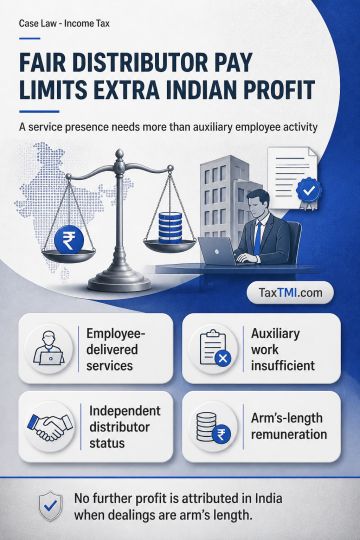
Service permanent establishment requires non-auxiliary services, while arm's-length distributor remuneration precludes further profit attribution in I...
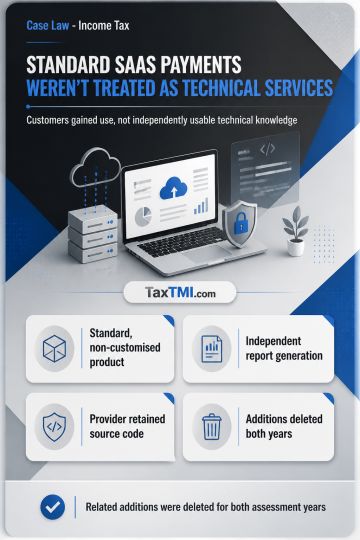
Make-available condition excludes standard SaaS subscription receipts where customers receive no independently usable technical knowledge after subscr...
Anonymous donation classification fails where charitable trusts maintain undisputed donor identity records and evidence corpus contributions' intended...
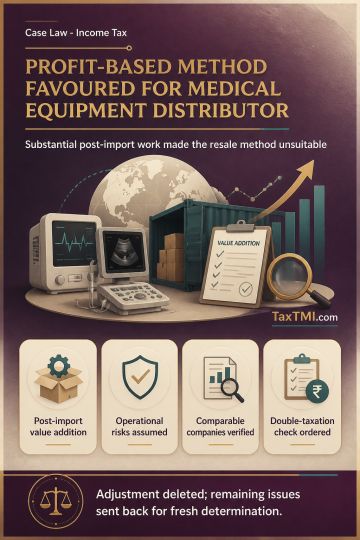
Transfer pricing method selection favours TNMM where medical-equipment distribution involves substantial post-import value addition and operational ri...
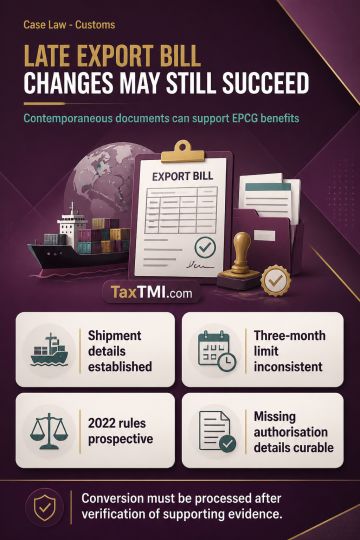
Post-export shipping bill conversion remains available where contemporaneous evidence supports EPCG benefits despite curable procedural omissions and ...
The CESTAT held that the appellant's training programme, approved by the Ministry of Skill Development & Entrepreneurship and conducted as a partner of the National Skill Development Corporation, qualifies for exemption from service tax under Sl. No. 9A of Notification No. 25/2012-ST. The Tribunal found the programme falls within the scope of approved vocational education courses eligible for exemption under Section 66D(1)(iii) of the Finance Act, 1994, rendering further discussion on this ground unnecessary. Regarding limitation, the Department's prior knowledge and acknowledgement of the appellant's activities precluded invocation of the extended period for tax recovery, as no suppression of facts was established. Accordingly, the demand confirmed against the appellant was set aside on limitation grounds. The appeal was allowed, with no service tax liability confirmed against the appellant.
The CESTAT held that the appellant's training programme, approved by the Ministry of Skill Development & Entrepreneurship and conducted as a partner of the National Skill Development Corporation, qualifies for exemption from service tax under Sl. No. 9A of Notification No. 25/2012-ST. The Tribunal found the programme falls within the scope of approved vocational education courses eligible for exemption under Section 66D(1)(iii) of the Finance Act, 1994, rendering further discussion on this ground unnecessary. Regarding limitation, the Department's prior knowledge and acknowledgement of the appellant's activities precluded invocation of the extended period for tax recovery, as no suppression of facts was established. Accordingly, the demand confirmed against the appellant was set aside on limitation grounds. The appeal was allowed, with no service tax liability confirmed against the appellant.
Note: It is a system-generated summary and is for quick reference only.
 TaxTMI
  TaxTMI
 of 4811












 Join Channel