Governmental authority status supports construction-service exemption, while pre-cutoff contract and stamp-duty compliance requires verification on re...
Automated Free Sale and Commerce Certificates enable paperless processing while retaining risk-based manual verification for selected exporter applica...
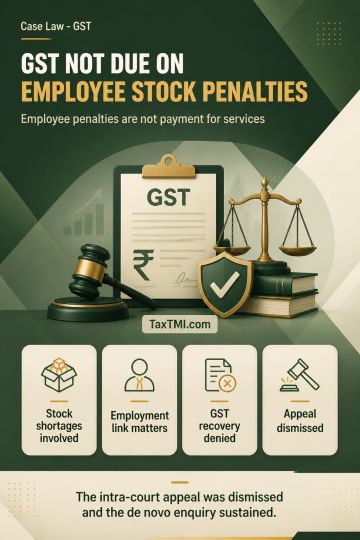
Employee stock-shortage penalties do not constitute consideration for services, preventing GST collection under Schedule II in employment relationship...
The HC dismissed the petitioner's application for regular bail under the PMLA, finding a prima facie case of money laundering linked to commission received as bribes for tender allotments. The petitioner, a former Cabinet Minister, was implicated through evidence showing a 1.35% commission share routed via his personal secretary. Statements recorded under Section 50 of the PMLA were held admissible and strongly implicated the petitioner. The Court emphasized the stringent twin conditions under Section 45 of the PMLA for bail, requiring reasonable grounds to believe the accused is not guilty and unlikely to reoffend, which were not met. The principle of parity was rejected as the petitioner's involvement was distinguishable and more direct than co-accused who had been granted bail. The Court concurred with the trial court's view that no exceptional circumstances justified bail, concluding the petitioner failed to establish entitlement to bail.
The HC dismissed the petitioner's application for regular bail under the PMLA, finding a prima facie case of money laundering linked to commission received as bribes for tender allotments. The petitioner, a former Cabinet Minister, was implicated through evidence showing a 1.35% commission share routed via his personal secretary. Statements recorded under Section 50 of the PMLA were held admissible and strongly implicated the petitioner. The Court emphasized the stringent twin conditions under Section 45 of the PMLA for bail, requiring reasonable grounds to believe the accused is not guilty and unlikely to reoffend, which were not met. The principle of parity was rejected as the petitioner's involvement was distinguishable and more direct than co-accused who had been granted bail. The Court concurred with the trial court's view that no exceptional circumstances justified bail, concluding the petitioner failed to establish entitlement to bail.
Note: It is a system-generated summary and is for quick reference only.
 TaxTMI
  TaxTMI
 of 4828













 Join Channel


