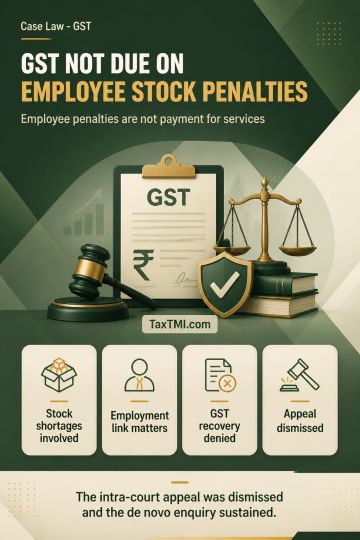
Employee stock-shortage penalties do not constitute consideration for services, preventing GST collection under Schedule II in employment relationship...
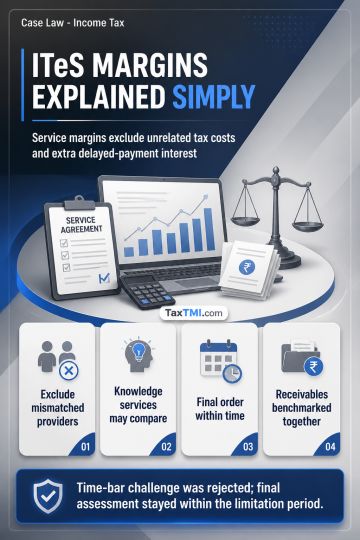
Transfer-pricing treatment of ITeS margins excludes pass-through tax recoveries and separate delayed-receivables interest after working-capital adjust...
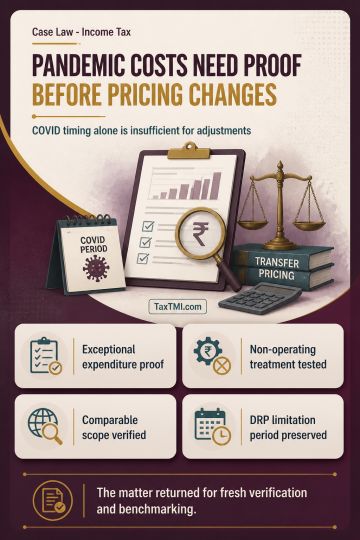
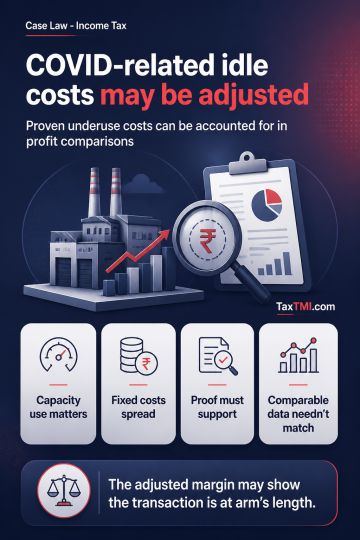
Capacity-utilisation adjustments under TNMM can neutralise substantiated COVID-related idle costs where underutilisation materially affects profitabil...
Page of 4830
Press 'Enter' after typing page number.
181 to 200 of 96587 Results
❮
❯
❯❯
0 / 200
Expand Note
Add to Folder
No Folders have been created
+
Are you sure you want to delete "My most important" ?
The HC upheld the ITAT's determination that the amount awarded to the Assessee pursuant to the arbitral award constituted business income rather than income from other sources. The Court agreed that the receipts were directly connected to the Assessee's commercial activities, specifically claims for nonpayment of dues related to offshore supplies, and thus fell within the scope of income from business. The HC rejected the AO's contention that the absence of regularity, continuity, frequency, and volume negated the characterisation as business income. Furthermore, the Court held that the taxability of such income must be assessed in accordance with Article 7 of the applicable India-Japan DTAA. Consequently, no substantial question of law arose warranting interference with the ITAT's decision.
The HC upheld the ITAT's determination that the amount awarded to the Assessee pursuant to the arbitral award constituted business income rather than income from other sources. The Court agreed that the receipts were directly connected to the Assessee's commercial activities, specifically claims for nonpayment of dues related to offshore supplies, and thus fell within the scope of income from business. The HC rejected the AO's contention that the absence of regularity, continuity, frequency, and volume negated the characterisation as business income. Furthermore, the Court held that the taxability of such income must be assessed in accordance with Article 7 of the applicable India-Japan DTAA. Consequently, no substantial question of law arose warranting interference with the ITAT's decision.
Note: It is a system-generated summary and is for quick reference only.
 TaxTMI
  TaxTMI
 of 4830









 Join Channel


