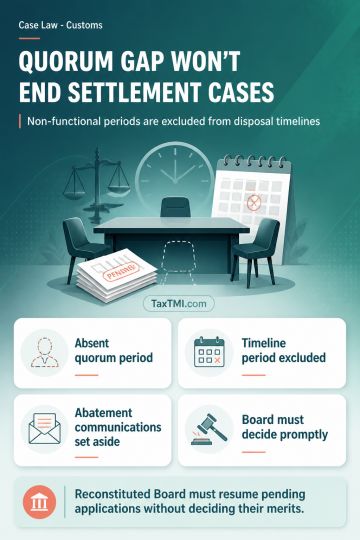
Post-search scrutiny assessment remains available where original assessment limitation is unexpired, permitting timely completion under regular assess...
Independent show-cause notices remain separate proceedings, while customs adjudication challenges should ordinarily follow the statutory appellate rem...
Institutional incapacity in customs settlement proceedings excludes non-functional quorum periods from statutory disposal timelines, preventing automa...
Page of 4788
Press 'Enter' after typing page number.
121 to 140 of 95749 Results
❮
❯
❯❯
0 / 200
Expand Note
Add to Folder
No Folders have been created
+
Are you sure you want to delete "My most important" ?
The HC held that the Kerala Joint Hindu Family System (Abolition) Act, 1975 (State Act) is repugnant to the Hindu Succession (Amendment) Act, 2005 (Central Act) under Article 254(1) of the Constitution. The State Act's provisions, which abolish coparcenary rights and deny daughters a birthright in joint family property, conflict irreconcilably with the Central Act, which recognizes daughters as coparceners by birth and restricts modes of partition to registered documents or court decrees. The Court overruled prior Kerala HC decisions that upheld the State Act's validity, emphasizing the binding Supreme Court precedent affirming daughters' coparcenary rights. Consequently, the Central Act prevails, granting female members equal succession rights in joint family property despite the State Act's contrary provisions. The substantial questions of law were answered in favor of the appellants, affirming that daughters acquire coparcenary rights by birth and the State Act cannot negate this entitlement.
The HC held that the Kerala Joint Hindu Family System (Abolition) Act, 1975 (State Act) is repugnant to the Hindu Succession (Amendment) Act, 2005 (Central Act) under Article 254(1) of the Constitution. The State Act's provisions, which abolish coparcenary rights and deny daughters a birthright in joint family property, conflict irreconcilably with the Central Act, which recognizes daughters as coparceners by birth and restricts modes of partition to registered documents or court decrees. The Court overruled prior Kerala HC decisions that upheld the State Act's validity, emphasizing the binding Supreme Court precedent affirming daughters' coparcenary rights. Consequently, the Central Act prevails, granting female members equal succession rights in joint family property despite the State Act's contrary provisions. The substantial questions of law were answered in favor of the appellants, affirming that daughters acquire coparcenary rights by birth and the State Act cannot negate this entitlement.
Note: It is a system-generated summary and is for quick reference only.
 TaxTMI
 of 4788



















 Join Channel


 TaxTMI