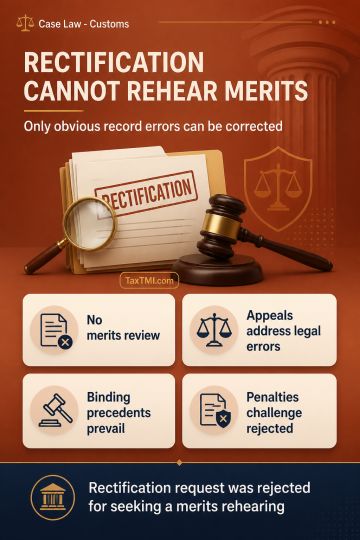
Rectification of mistake remains limited to self-evident record errors, preventing merits review through miscellaneous applications and preserving fin...
Tender creditworthiness conditions may extend to de facto Promoter Directors, with post-participation challenges generally barred absent arbitrariness...
Corporate representation in PMLA summons proceedings permitted through an authorised signatory, subject to directors' continuing cooperation and atten...
Helicopter charter classification requires effective control analysis, while territorial performance, reasoned credit orders and wilful suppression de...
Page of 4796
Press 'Enter' after typing page number.
781 to 800 of 95918 Results
❮
❯
❯❯
0 / 200
Expand Note
Add to Folder
No Folders have been created
+
Are you sure you want to delete "My most important" ?
The HC held that the Kerala Joint Hindu Family System (Abolition) Act, 1975 (State Act) is repugnant to the Hindu Succession (Amendment) Act, 2005 (Central Act) under Article 254(1) of the Constitution. The State Act's provisions, which abolish coparcenary rights and deny daughters a birthright in joint family property, conflict irreconcilably with the Central Act, which recognizes daughters as coparceners by birth and restricts modes of partition to registered documents or court decrees. The Court overruled prior Kerala HC decisions that upheld the State Act's validity, emphasizing the binding Supreme Court precedent affirming daughters' coparcenary rights. Consequently, the Central Act prevails, granting female members equal succession rights in joint family property despite the State Act's contrary provisions. The substantial questions of law were answered in favor of the appellants, affirming that daughters acquire coparcenary rights by birth and the State Act cannot negate this entitlement.
The HC held that the Kerala Joint Hindu Family System (Abolition) Act, 1975 (State Act) is repugnant to the Hindu Succession (Amendment) Act, 2005 (Central Act) under Article 254(1) of the Constitution. The State Act's provisions, which abolish coparcenary rights and deny daughters a birthright in joint family property, conflict irreconcilably with the Central Act, which recognizes daughters as coparceners by birth and restricts modes of partition to registered documents or court decrees. The Court overruled prior Kerala HC decisions that upheld the State Act's validity, emphasizing the binding Supreme Court precedent affirming daughters' coparcenary rights. Consequently, the Central Act prevails, granting female members equal succession rights in joint family property despite the State Act's contrary provisions. The substantial questions of law were answered in favor of the appellants, affirming that daughters acquire coparcenary rights by birth and the State Act cannot negate this entitlement.
Note: It is a system-generated summary and is for quick reference only.
 TaxTMI
 of 4796




















 Join Channel


 TaxTMI