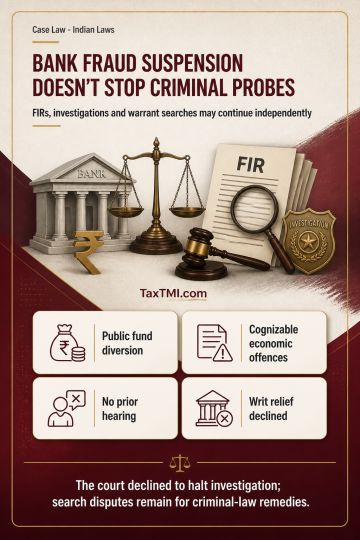
Administrative fraud classification suspension does not halt independent criminal investigation or warrant-based searches into alleged economic offenc...
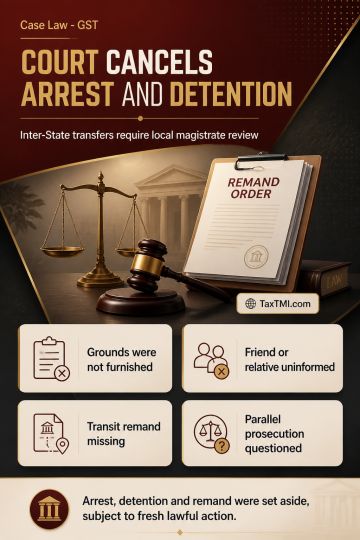
Arrest safeguards and transit remand requirements invalidated detention following inter-State transfer without communicated grounds or magistrate auth...
Arrest safeguards require disclosed grounds, relative intimation and transit remand, while duplicate prosecution under the CGST framework is unsustain...
Document Identification Number defects can invalidate GST assessments, with delayed challenges entertained conditionally where patent irregularities e...
The HC held that notifications issued under Section 168A CGST Act, purportedly extending limitation periods, must be strictly construed as exceptions to Section 73. The impugned notifications lacked a valid recommendation from the GST Council based on relevant material, rendering them unsustainable. While the GST Council's recommendation is mandatory, it is not binding on the government; however, post-issuance ratification by the Council does not cure the defect of absence of prior recommendation. The Court distinguished between extension of limitation (Section 168A) and computation of limitation (Supreme Court's orders under Article 142), holding that the notifications erroneously diminished limitation periods contrary to the Supreme Court's orders, thus violating legislative intent. Consequently, the notifications were quashed, and all matters were remanded to assessing authorities for fresh adjudication consistent with these findings.
The HC held that notifications issued under Section 168A CGST Act, purportedly extending limitation periods, must be strictly construed as exceptions to Section 73. The impugned notifications lacked a valid recommendation from the GST Council based on relevant material, rendering them unsustainable. While the GST Council's recommendation is mandatory, it is not binding on the government; however, post-issuance ratification by the Council does not cure the defect of absence of prior recommendation. The Court distinguished between extension of limitation (Section 168A) and computation of limitation (Supreme Court's orders under Article 142), holding that the notifications erroneously diminished limitation periods contrary to the Supreme Court's orders, thus violating legislative intent. Consequently, the notifications were quashed, and all matters were remanded to assessing authorities for fresh adjudication consistent with these findings.
Note: It is a system-generated summary and is for quick reference only.
 TaxTMI
 of 4803










 Join Channel


 TaxTMI
