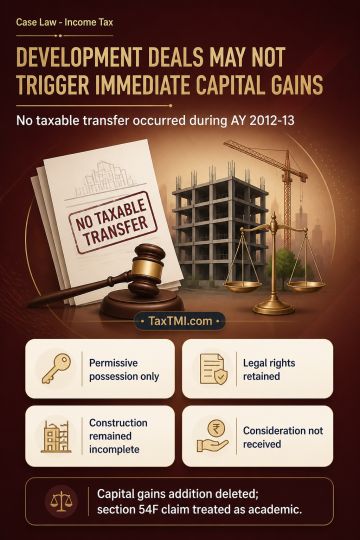
Development agreements require legal possession or effective enjoyment for capital gains transfer; permissive possession and deferred consideration de...
Prolonged sterilisation of development rights supports capital-gains treatment, while business-income disallowances cannot govern capital-gains comput...
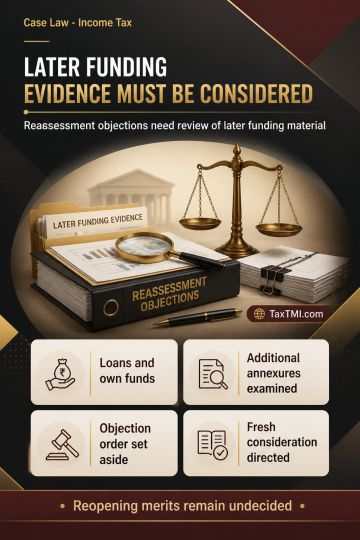
Additional evidence in transfer pricing dispute leads to fresh examination, while tax deductions, TDS credit, fee and refund interest require verifica...
Category II AIF pass-through taxation preserves non-business income character; investment receipts cannot be reclassified without applying recognised ...
The ITAT held that the penalty imposed under sections 271D and 271E was invalid as the penalty order was passed beyond the limitation period prescribed under section 275(1)(c). The statute mandates that penalty proceedings must be completed either by the later of two periods: March 31 following the financial year in which the assessment proceedings concluded, or within six months from the end of the month in which the penalty proceedings were initiated. Since the penalty order was passed on January 31, 2024, exceeding the prescribed deadline of June 30, 2023, it was held time-barred. Reliance on precedent confirmed that penalties imposed after the prescribed limitation period are not sustainable. Consequently, the penalty order was quashed, and the appellant's appeal was allowed.
The ITAT held that the penalty imposed under sections 271D and 271E was invalid as the penalty order was passed beyond the limitation period prescribed under section 275(1)(c). The statute mandates that penalty proceedings must be completed either by the later of two periods: March 31 following the financial year in which the assessment proceedings concluded, or within six months from the end of the month in which the penalty proceedings were initiated. Since the penalty order was passed on January 31, 2024, exceeding the prescribed deadline of June 30, 2023, it was held time-barred. Reliance on precedent confirmed that penalties imposed after the prescribed limitation period are not sustainable. Consequently, the penalty order was quashed, and the appellant's appeal was allowed.
Note: It is a system-generated summary and is for quick reference only.
 TaxTMI
 of 4805


















 Join Channel


 TaxTMI
