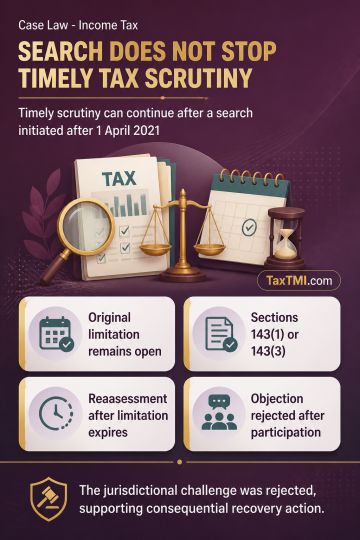
Post-search scrutiny assessment remains available where original assessment limitation is unexpired, permitting timely completion under regular assess...
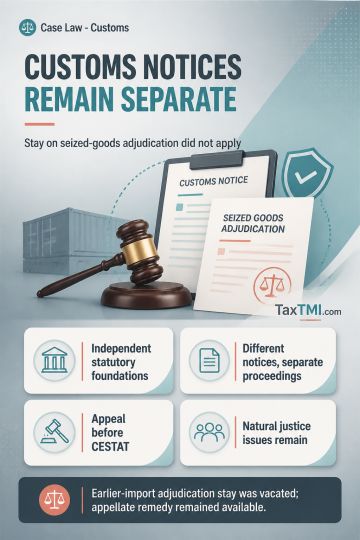
Independent show-cause notices remain separate proceedings, while customs adjudication challenges should ordinarily follow the statutory appellate rem...
Page of 4788
Press 'Enter' after typing page number.
121 to 140 of 95752 Results
❮
❯
❯❯
0 / 200
Expand Note
Add to Folder
No Folders have been created
+
Are you sure you want to delete "My most important" ?
The ITAT upheld the CIT(A)'s deletion of additions made under sections 69A and 153C/143(3) against the assessee, which were based on notings found in loose sheets seized from a third party's premises. The tribunal held that the presumption under section 132(4A) applies only to documents belonging to the searched person, not to third-party records. The AO failed to provide cogent evidence linking the seized notings, which merely contained the assessee's name and amounts without reference to loans or interest, to the assessee. The AO also did not examine the third party or conduct independent inquiries, relying instead on assumptions and uncorroborated loose papers. Consequently, the entries were deemed inadmissible as conclusive proof against the assessee. The tribunal affirmed that surmise and conjecture cannot substitute independent corroborative evidence, resulting in the allowance of the assessee's appeal and deletion of the additions.
The ITAT upheld the CIT(A)'s deletion of additions made under sections 69A and 153C/143(3) against the assessee, which were based on notings found in loose sheets seized from a third party's premises. The tribunal held that the presumption under section 132(4A) applies only to documents belonging to the searched person, not to third-party records. The AO failed to provide cogent evidence linking the seized notings, which merely contained the assessee's name and amounts without reference to loans or interest, to the assessee. The AO also did not examine the third party or conduct independent inquiries, relying instead on assumptions and uncorroborated loose papers. Consequently, the entries were deemed inadmissible as conclusive proof against the assessee. The tribunal affirmed that surmise and conjecture cannot substitute independent corroborative evidence, resulting in the allowance of the assessee's appeal and deletion of the additions.
Note: It is a system-generated summary and is for quick reference only.
 TaxTMI
 of 4788




 Join Channel


 TaxTMI