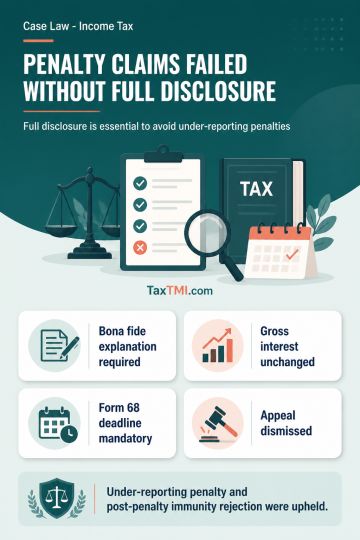
Bona fide disclosure requirements govern under-reporting penalties, and post-penalty immunity applications cannot secure available statutory protectio...
Certificate-of-origin verification procedure governs preferential customs benefits; denial without retroactive verification was set aside with consequ...
Disciplinary Committee jurisdiction and mandatory investigation requirements invalidated cancellation of an insolvency professional's registration and...
The ITAT held that the assessee, engaged in reinsurance, does not constitute a permanent establishment (PE) in India under the modified Article 5 of the MLI between India and Ireland. Despite the revenue's contention that the assessee and a related enterprise carried out complementary functions amounting to a cohesive business operation in India, the tribunal found no business activities or presence in India, including no premises or acceptance of risk within India. Consequently, the anti-fragmentation rule under the MLI, designed to prevent abuse of preparatory or auxiliary activity exemptions, was inapplicable. The tribunal concluded that the assessee's income was not taxable in India due to the absence of a PE, ruling in favor of the assessee.
The ITAT held that the assessee, engaged in reinsurance, does not constitute a permanent establishment (PE) in India under the modified Article 5 of the MLI between India and Ireland. Despite the revenue's contention that the assessee and a related enterprise carried out complementary functions amounting to a cohesive business operation in India, the tribunal found no business activities or presence in India, including no premises or acceptance of risk within India. Consequently, the anti-fragmentation rule under the MLI, designed to prevent abuse of preparatory or auxiliary activity exemptions, was inapplicable. The tribunal concluded that the assessee's income was not taxable in India due to the absence of a PE, ruling in favor of the assessee.
Note: It is a system-generated summary and is for quick reference only.
 TaxTMI
 of 4800











 Join Channel


 TaxTMI
