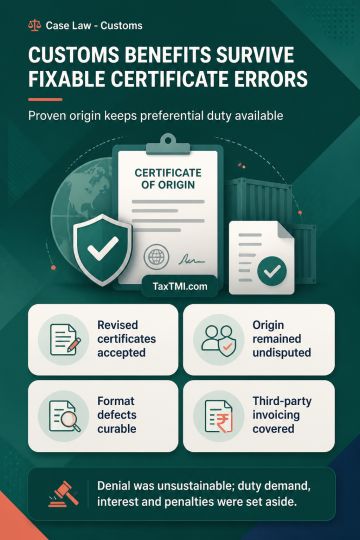
Opportunity to respond to jurisdictional reports is mandatory before customs settlement duty enhancement; connected applications require consistent ad...
Specific customs headings for scaffolding components prevail over general classification, invalidating misclassification proceedings and enabling with...
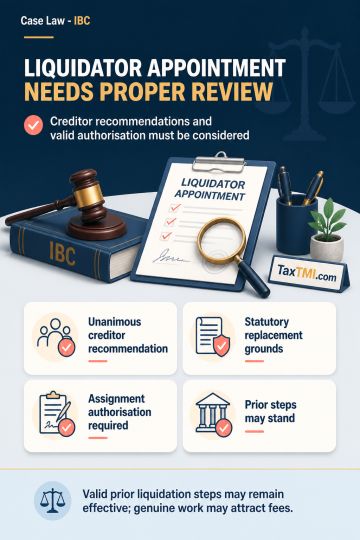
Liquidator appointment under Section 34 requires consideration of creditor recommendations, valid professional authorisation, and preservation of vali...
Page of 4790
Press 'Enter' after typing page number.
361 to 380 of 95794 Results
❮
❯
❯❯
0 / 200
Expand Note
Add to Folder
No Folders have been created
+
Are you sure you want to delete "My most important" ?
The ITAT held that the assessee, engaged in reinsurance, does not constitute a permanent establishment (PE) in India under the modified Article 5 of the MLI between India and Ireland. Despite the revenue's contention that the assessee and a related enterprise carried out complementary functions amounting to a cohesive business operation in India, the tribunal found no business activities or presence in India, including no premises or acceptance of risk within India. Consequently, the anti-fragmentation rule under the MLI, designed to prevent abuse of preparatory or auxiliary activity exemptions, was inapplicable. The tribunal concluded that the assessee's income was not taxable in India due to the absence of a PE, ruling in favor of the assessee.
The ITAT held that the assessee, engaged in reinsurance, does not constitute a permanent establishment (PE) in India under the modified Article 5 of the MLI between India and Ireland. Despite the revenue's contention that the assessee and a related enterprise carried out complementary functions amounting to a cohesive business operation in India, the tribunal found no business activities or presence in India, including no premises or acceptance of risk within India. Consequently, the anti-fragmentation rule under the MLI, designed to prevent abuse of preparatory or auxiliary activity exemptions, was inapplicable. The tribunal concluded that the assessee's income was not taxable in India due to the absence of a PE, ruling in favor of the assessee.
Note: It is a system-generated summary and is for quick reference only.
 TaxTMI
 of 4790














 Join Channel


 TaxTMI