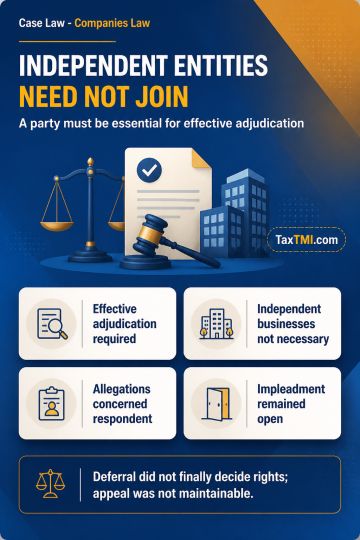
Necessary-party requirements limit impleadment of independent entities, while deferred consideration does not create an appealable adverse determinati...
Food supplement classification requires common parlance and authoritative tests, preventing treatment as proprietary Ayurvedic medicines without suppo...
Specified regulatory authority income receives conditional tax exemption, subject to non-commercial activity, unchanged income character, and return f...
Tax exemption for regulatory authority income applies retrospectively, subject to non-commercial activity, unchanged income sources, and return-filing...
Input tax credit conditions remain constitutionally valid, with eligible recipient claims considered under GST circulars and retrospective filing dead...
The HC held that the impugned G.O.s issued by the State prohibiting theatre owners from collecting convenience fees on online ticket bookings lacked statutory authority under the ED Act, as Sections 7, 10, and 4(2)(b) do not empower such prohibition. The Court found that these G.O.s violated Article 19(1)(g) as they imposed an unreasonable restriction without legislative backing, being mere executive orders rather than valid laws. Furthermore, the G.O.s could not be upheld under Article 162, as they did not constitute valid State decisions fulfilling constitutional requirements. Consequently, the Court declared clauses prohibiting collection of convenience fees unconstitutional and quashed them, affirming the fundamental right of theatre owners to conduct their business without unlawful restraint. The petition was allowed, restoring the right to collect convenience fees on online ticket bookings.
The HC held that the impugned G.O.s issued by the State prohibiting theatre owners from collecting convenience fees on online ticket bookings lacked statutory authority under the ED Act, as Sections 7, 10, and 4(2)(b) do not empower such prohibition. The Court found that these G.O.s violated Article 19(1)(g) as they imposed an unreasonable restriction without legislative backing, being mere executive orders rather than valid laws. Furthermore, the G.O.s could not be upheld under Article 162, as they did not constitute valid State decisions fulfilling constitutional requirements. Consequently, the Court declared clauses prohibiting collection of convenience fees unconstitutional and quashed them, affirming the fundamental right of theatre owners to conduct their business without unlawful restraint. The petition was allowed, restoring the right to collect convenience fees on online ticket bookings.
Note: It is a system-generated summary and is for quick reference only.
 TaxTMI
 of 4792

















 Join Channel


 TaxTMI

