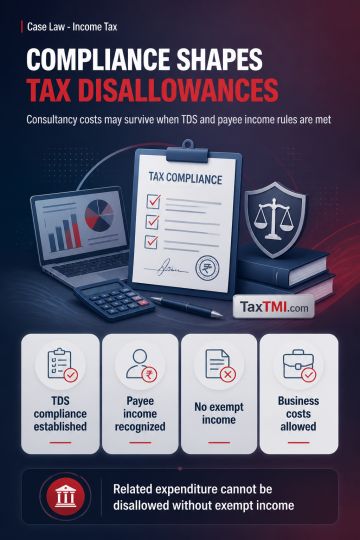
Tax deduction compliance and payee income recognition govern consultancy disallowance, while no exempt income prevents related expenditure disallowanc...
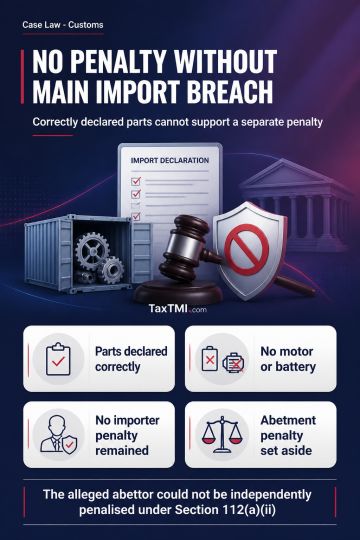
Derivative abetment liability fails when correctly declared imported components establish no underlying improper importation by the principal importer...
Tax exemption for regulatory authority income applies retrospectively, subject to non-commercial activity, unchanged income sources, and return filing...
Page of 4788
Press 'Enter' after typing page number.
361 to 380 of 95752 Results
❮
❯
❯❯
0 / 200
Expand Note
Add to Folder
No Folders have been created
+
Are you sure you want to delete "My most important" ?
The CESTAT held that the appellant's services do not qualify as those rendered by an authorised service station under Section 65(105)(zo) read with Section 69(9) of the Finance Act, 1994; hence, the demand of service tax on that ground is unsustainable. The Tribunal further found the demand under the Reverse Charge Mechanism (RCM) for the period April 2005 to March 2008 to be time-barred, as the show-cause notice was issued beyond the prescribed limitation period. Additionally, since the appellant had discharged the service tax liability under RCM and was entitled to claim CENVAT credit, the penalty and extended period invocation were unjustified. In light of the revenue-neutral position and precedent, the Tribunal set aside the impugned order, quashing the confirmed demand and penalty, thereby allowing the appeal.
The CESTAT held that the appellant's services do not qualify as those rendered by an authorised service station under Section 65(105)(zo) read with Section 69(9) of the Finance Act, 1994; hence, the demand of service tax on that ground is unsustainable. The Tribunal further found the demand under the Reverse Charge Mechanism (RCM) for the period April 2005 to March 2008 to be time-barred, as the show-cause notice was issued beyond the prescribed limitation period. Additionally, since the appellant had discharged the service tax liability under RCM and was entitled to claim CENVAT credit, the penalty and extended period invocation were unjustified. In light of the revenue-neutral position and precedent, the Tribunal set aside the impugned order, quashing the confirmed demand and penalty, thereby allowing the appeal.
Note: It is a system-generated summary and is for quick reference only.
 TaxTMI
 of 4788











 Join Channel


 TaxTMI
