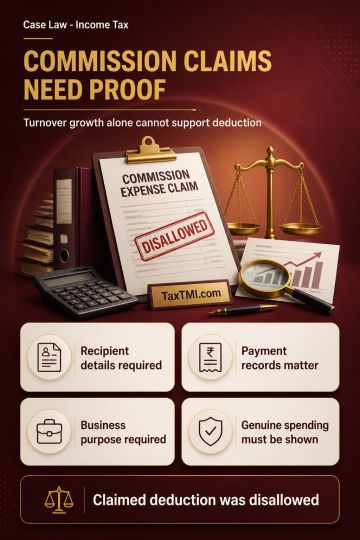
Business expenditure deduction requires proof of genuine commission payments and commercial allowability; turnover growth alone cannot validate the cl...
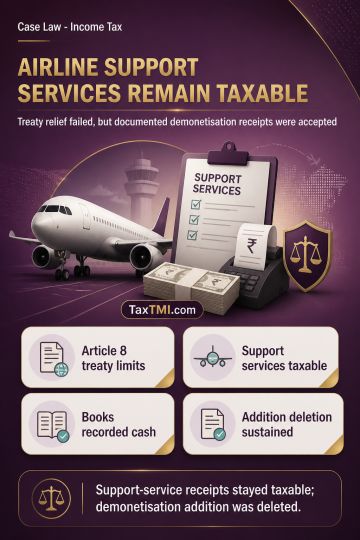
Article 8 treaty coverage excluded third-party airline support services, while documented demonetisation cash receipts remained accepted business inco...
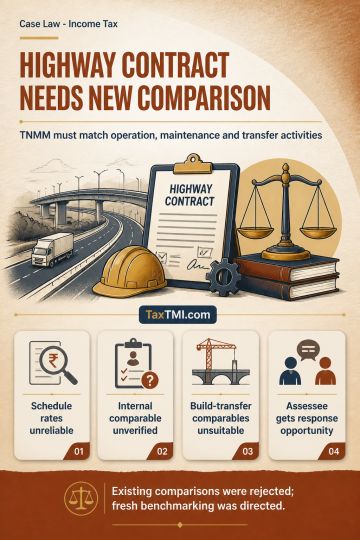
Functional comparability under TNMM requires highway contract benchmarks to reflect operation, maintenance and transfer activities, requiring fresh be...
Page of 4786
Press 'Enter' after typing page number.
241 to 260 of 95715 Results
❮
❯
❯❯
0 / 200
Expand Note
Add to Folder
No Folders have been created
+
Are you sure you want to delete "My most important" ?
The CESTAT held that the appellant's services do not qualify as those rendered by an authorised service station under Section 65(105)(zo) read with Section 69(9) of the Finance Act, 1994; hence, the demand of service tax on that ground is unsustainable. The Tribunal further found the demand under the Reverse Charge Mechanism (RCM) for the period April 2005 to March 2008 to be time-barred, as the show-cause notice was issued beyond the prescribed limitation period. Additionally, since the appellant had discharged the service tax liability under RCM and was entitled to claim CENVAT credit, the penalty and extended period invocation were unjustified. In light of the revenue-neutral position and precedent, the Tribunal set aside the impugned order, quashing the confirmed demand and penalty, thereby allowing the appeal.
The CESTAT held that the appellant's services do not qualify as those rendered by an authorised service station under Section 65(105)(zo) read with Section 69(9) of the Finance Act, 1994; hence, the demand of service tax on that ground is unsustainable. The Tribunal further found the demand under the Reverse Charge Mechanism (RCM) for the period April 2005 to March 2008 to be time-barred, as the show-cause notice was issued beyond the prescribed limitation period. Additionally, since the appellant had discharged the service tax liability under RCM and was entitled to claim CENVAT credit, the penalty and extended period invocation were unjustified. In light of the revenue-neutral position and precedent, the Tribunal set aside the impugned order, quashing the confirmed demand and penalty, thereby allowing the appeal.
Note: It is a system-generated summary and is for quick reference only.
 TaxTMI
 of 4786





 Join Channel


 TaxTMI