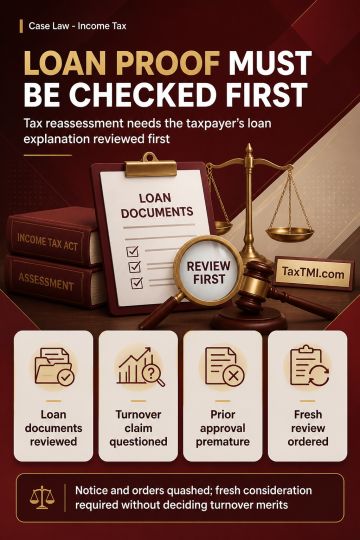
Opportunity to furnish unsecured-loan confirmations is required before reassessment initiation; proceedings require fresh consideration after taxpayer...
Under-reporting on a first reassessment return attracts penalty, while enhanced misreporting penalty requires proof of a statutory misreporting catego...
The HC upheld the findings of the CIT(A) and ITAT that the transfer of divisions to two companies did not constitute a 'demerger' under Section 72A(4) of the IT Act. The court confirmed that for Section 72A(4) to apply, there must be a transfer of all assets and liabilities of the division to the resulting company, and consideration must be paid by share issuance to the shareholders of the demerged company. Here, only specified assets and liabilities were transferred, and consideration was paid in cash, approved under company law. Consequently, carry forward of business loss and unabsorbed depreciation was permitted, and no substantial question of law arose.
The HC upheld the findings of the CIT(A) and ITAT that the transfer of divisions to two companies did not constitute a 'demerger' under Section 72A(4) of the IT Act. The court confirmed that for Section 72A(4) to apply, there must be a transfer of all assets and liabilities of the division to the resulting company, and consideration must be paid by share issuance to the shareholders of the demerged company. Here, only specified assets and liabilities were transferred, and consideration was paid in cash, approved under company law. Consequently, carry forward of business loss and unabsorbed depreciation was permitted, and no substantial question of law arose.
Note: It is a system-generated summary and is for quick reference only.
 TaxTMI
  TaxTMI
 of 4915