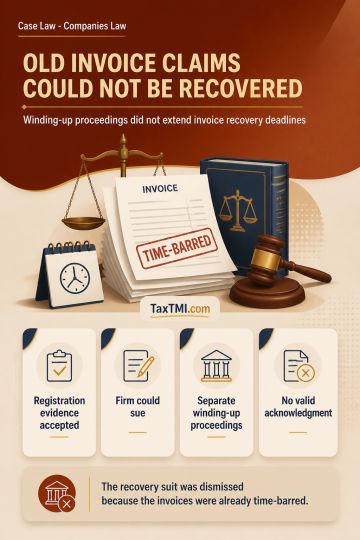
Invoice-based recovery claims remain time-barred despite separate winding-up proceedings, absent valid acknowledgment or part-payment of the disputed ...
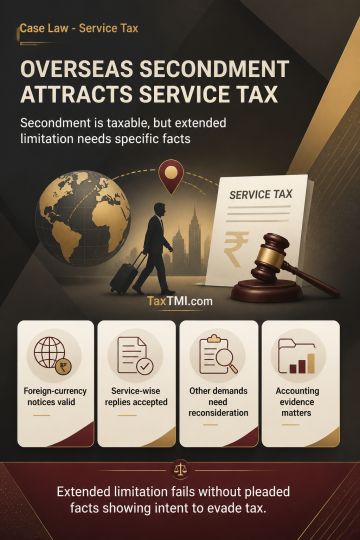
Extended limitation fails without specific suppression allegations, while overseas employee secondment remains taxable as manpower supply within norma...
Time-share accommodation classification excludes Club or Association Service where purchasers receive contractual occupancy rights without genuine mem...
CENVAT credit for trading requires reversal, while taxable-service rental credit remains proportionately available and limitation issues await resolut...
Page of 4792
Press 'Enter' after typing page number.
61 to 80 of 95833 Results
❮
❯
❯❯
0 / 200
Expand Note
Add to Folder
No Folders have been created
+
Are you sure you want to delete "My most important" ?
The ITAT upheld the exemption under section 11 for the assessee, a development authority, recognizing it as a charitable entity within the meaning of section 2(15), consistent with prior decisions and Supreme Court precedents. The proviso to section 2(15) was held inapplicable, as the assessee's object included providing shelter to the homeless. Additionally, amounts credited to the infrastructure development and reserve funds were held not taxable in the assessee's hands, since these funds belong to the State and the assessee acts merely as custodian. The tribunal concluded that utilization of these funds for general utility further supported exemption, thereby deciding all grounds in favor of the assessee.
The ITAT upheld the exemption under section 11 for the assessee, a development authority, recognizing it as a charitable entity within the meaning of section 2(15), consistent with prior decisions and Supreme Court precedents. The proviso to section 2(15) was held inapplicable, as the assessee's object included providing shelter to the homeless. Additionally, amounts credited to the infrastructure development and reserve funds were held not taxable in the assessee's hands, since these funds belong to the State and the assessee acts merely as custodian. The tribunal concluded that utilization of these funds for general utility further supported exemption, thereby deciding all grounds in favor of the assessee.
Note: It is a system-generated summary and is for quick reference only.
 TaxTMI
 of 4792










 Join Channel


 TaxTMI

