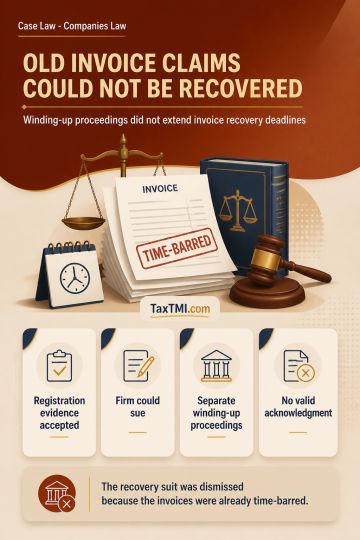
Invoice-based recovery claims remain time-barred despite separate winding-up proceedings, absent valid acknowledgment or part-payment of the disputed ...
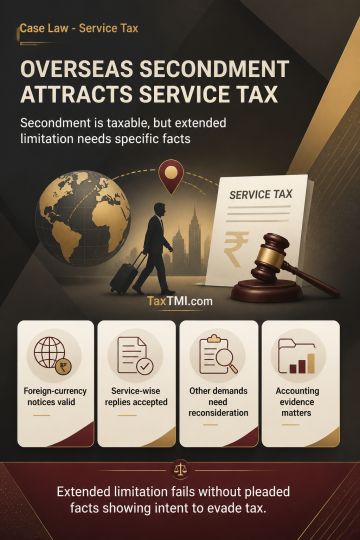
Extended limitation fails without specific suppression allegations, while overseas employee secondment remains taxable as manpower supply within norma...
Time-share accommodation classification excludes Club or Association Service where purchasers receive contractual occupancy rights without genuine mem...
CENVAT credit for trading requires reversal, while taxable-service rental credit remains proportionately available and limitation issues await resolut...
Page of 4792
Press 'Enter' after typing page number.
61 to 80 of 95833 Results
❮
❯
❯❯
0 / 200
Expand Note
Add to Folder
No Folders have been created
+
Are you sure you want to delete "My most important" ?
The CESTAT upheld the imposition of penalties on the appellant CHA under Sections 112, 114, and 114AA of the Customs Act, 1962, rejecting the appellant's claim of lack of mens rea regarding the mis-declared and overvalued consignment. The Tribunal found no violation of natural justice as additional submissions were considered in the impugned order. The appellant failed to produce the importer or proprietor despite summons and submitted misleading information about delivery of summons. The appellant lacked authorization to receive KYC documents, which were found to be incorrect and unverifiable. Consequently, the Tribunal concluded there was no error apparent on the face of the record and dismissed the rectification application.
The CESTAT upheld the imposition of penalties on the appellant CHA under Sections 112, 114, and 114AA of the Customs Act, 1962, rejecting the appellant's claim of lack of mens rea regarding the mis-declared and overvalued consignment. The Tribunal found no violation of natural justice as additional submissions were considered in the impugned order. The appellant failed to produce the importer or proprietor despite summons and submitted misleading information about delivery of summons. The appellant lacked authorization to receive KYC documents, which were found to be incorrect and unverifiable. Consequently, the Tribunal concluded there was no error apparent on the face of the record and dismissed the rectification application.
Note: It is a system-generated summary and is for quick reference only.
 TaxTMI
 of 4792










 Join Channel


 TaxTMI

