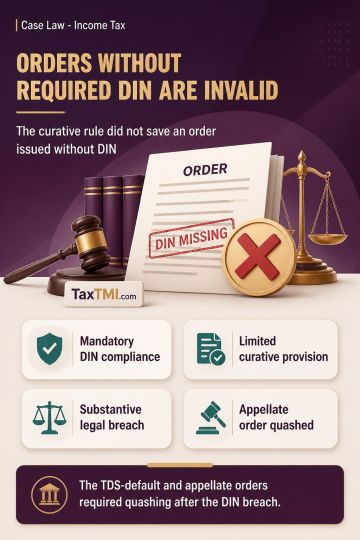
Document Identification Number compliance renders TDS-default orders invalid where mandatory DIN requirements are breached and curative provision does...
ITAT quashed assessment orders under Section 153C for Assessment Years 2008-09 to 2012-13, ruling the Assessing Officer lacked jurisdiction to initiate proceedings. For AY 2008-09, the satisfaction note was recorded on 23.09.2014, falling outside the statutorily permissible six-year limitation period under the second proviso to Section 153A(1). For AYs 2009-10 to 2012-13, the tribunal found fundamental jurisdictional defects: absence of proper satisfaction recording linking seized material to the assessee, no contemporaneous satisfaction by the searched person's AO, mechanical use of templated satisfaction notes across multiple years, and complete absence of incriminating material analysis. The satisfaction note failed to establish any nexus between seized diary entries and undisclosed income. Following Supreme Court precedents in Calcutta Knitwears and Jasjit Singh, the tribunal held that lacking valid jurisdictional foundation renders assessments void ab initio. Appeal allowed.
ITAT quashed assessment orders under Section 153C for Assessment Years 2008-09 to 2012-13, ruling the Assessing Officer lacked jurisdiction to initiate proceedings. For AY 2008-09, the satisfaction note was recorded on 23.09.2014, falling outside the statutorily permissible six-year limitation period under the second proviso to Section 153A(1). For AYs 2009-10 to 2012-13, the tribunal found fundamental jurisdictional defects: absence of proper satisfaction recording linking seized material to the assessee, no contemporaneous satisfaction by the searched person's AO, mechanical use of templated satisfaction notes across multiple years, and complete absence of incriminating material analysis. The satisfaction note failed to establish any nexus between seized diary entries and undisclosed income. Following Supreme Court precedents in Calcutta Knitwears and Jasjit Singh, the tribunal held that lacking valid jurisdictional foundation renders assessments void ab initio. Appeal allowed.
Note: It is a system-generated summary and is for quick reference only.
 TaxTMI
  TaxTMI
 of 4918