Toy balloon tariff classification: functional heading prevails over residual rubber and festive article headings, supporting penalties for deliberate ...
Customs valuation using comparable contemporaneous imports can displace declared value, while missing speaking orders require pursuit before competent...
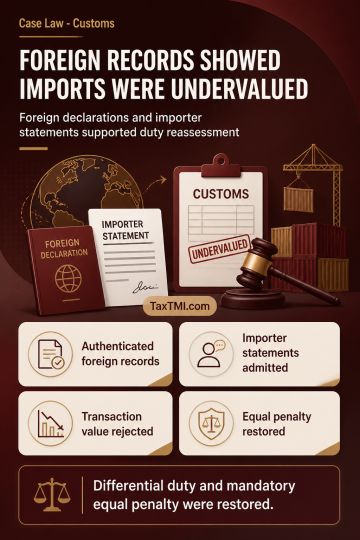
Foreign customs declarations and importer admissions established undervaluation, supporting sequential value redetermination, differential duty, and m...
Customs seizure safeguards prevent detention-based limitation avoidance and invalidate provisional release conditions for imported vehicles under an i...
Page of 4828
Press 'Enter' after typing page number.
361 to 380 of 96556 Results
❮
❯
❯❯
0 / 200
Expand Note
Add to Folder
No Folders have been created
+
Are you sure you want to delete "My most important" ?
ITAT quashed assessment orders under Section 153C for Assessment Years 2008-09 to 2012-13, ruling the Assessing Officer lacked jurisdiction to initiate proceedings. For AY 2008-09, the satisfaction note was recorded on 23.09.2014, falling outside the statutorily permissible six-year limitation period under the second proviso to Section 153A(1). For AYs 2009-10 to 2012-13, the tribunal found fundamental jurisdictional defects: absence of proper satisfaction recording linking seized material to the assessee, no contemporaneous satisfaction by the searched person's AO, mechanical use of templated satisfaction notes across multiple years, and complete absence of incriminating material analysis. The satisfaction note failed to establish any nexus between seized diary entries and undisclosed income. Following Supreme Court precedents in Calcutta Knitwears and Jasjit Singh, the tribunal held that lacking valid jurisdictional foundation renders assessments void ab initio. Appeal allowed.
ITAT quashed assessment orders under Section 153C for Assessment Years 2008-09 to 2012-13, ruling the Assessing Officer lacked jurisdiction to initiate proceedings. For AY 2008-09, the satisfaction note was recorded on 23.09.2014, falling outside the statutorily permissible six-year limitation period under the second proviso to Section 153A(1). For AYs 2009-10 to 2012-13, the tribunal found fundamental jurisdictional defects: absence of proper satisfaction recording linking seized material to the assessee, no contemporaneous satisfaction by the searched person's AO, mechanical use of templated satisfaction notes across multiple years, and complete absence of incriminating material analysis. The satisfaction note failed to establish any nexus between seized diary entries and undisclosed income. Following Supreme Court precedents in Calcutta Knitwears and Jasjit Singh, the tribunal held that lacking valid jurisdictional foundation renders assessments void ab initio. Appeal allowed.
Note: It is a system-generated summary and is for quick reference only.
 TaxTMI
  TaxTMI
 of 4828


















 Join Channel