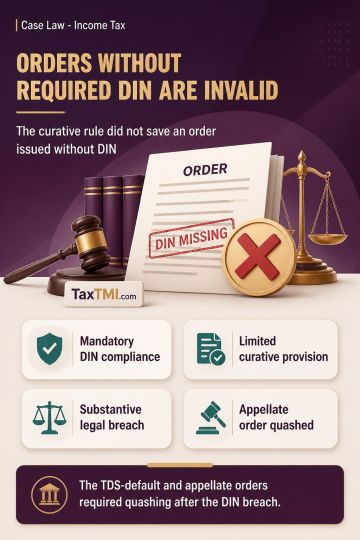
Document Identification Number compliance renders TDS-default orders invalid where mandatory DIN requirements are breached and curative provision does...
ITAT deleted penalty under section 271(1)(c) imposed on assessee for two fundamental reasons. First, the penalty notice under section 274 was defective as it failed to specify whether the charge pertained to concealment of income or furnishing inaccurate particulars, rendering the penalty procedurally invalid. Second, the Assessing Officer made additions on ad hoc basis by disallowing ten percent of Magazine and Journal expenses without concrete evidence, treating them as unjustified and excessive. The tribunal held that penalty cannot be levied on estimated income additions made without specific evidence of concealment or wilful default. Following established precedent, mere rejection of books and assessment on estimate basis does not establish fraud or gross negligence warranting penalty imposition. Appeal decided in favour of assessee with complete deletion of disputed penalty.
ITAT deleted penalty under section 271(1)(c) imposed on assessee for two fundamental reasons. First, the penalty notice under section 274 was defective as it failed to specify whether the charge pertained to concealment of income or furnishing inaccurate particulars, rendering the penalty procedurally invalid. Second, the Assessing Officer made additions on ad hoc basis by disallowing ten percent of Magazine and Journal expenses without concrete evidence, treating them as unjustified and excessive. The tribunal held that penalty cannot be levied on estimated income additions made without specific evidence of concealment or wilful default. Following established precedent, mere rejection of books and assessment on estimate basis does not establish fraud or gross negligence warranting penalty imposition. Appeal decided in favour of assessee with complete deletion of disputed penalty.
Note: It is a system-generated summary and is for quick reference only.
 TaxTMI
  TaxTMI
 of 4918