Toy balloon tariff classification: functional heading prevails over residual rubber and festive article headings, supporting penalties for deliberate ...
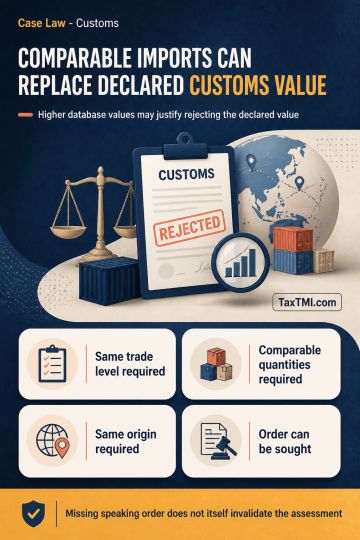
Customs valuation using comparable contemporaneous imports can displace declared value, while missing speaking orders require pursuit before competent...
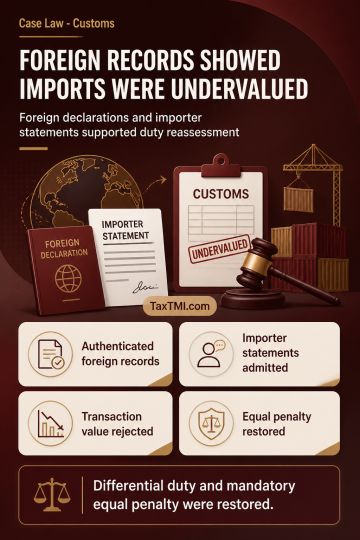
Foreign customs declarations and importer admissions established undervaluation, supporting sequential value redetermination, differential duty, and m...
Customs seizure safeguards prevent detention-based limitation avoidance and invalidate provisional release conditions for imported vehicles under an i...
Page of 4828
Press 'Enter' after typing page number.
361 to 380 of 96556 Results
❮
❯
❯❯
0 / 200
Expand Note
Add to Folder
No Folders have been created
+
Are you sure you want to delete "My most important" ?
ITAT deleted penalty under section 271(1)(c) imposed on assessee for two fundamental reasons. First, the penalty notice under section 274 was defective as it failed to specify whether the charge pertained to concealment of income or furnishing inaccurate particulars, rendering the penalty procedurally invalid. Second, the Assessing Officer made additions on ad hoc basis by disallowing ten percent of Magazine and Journal expenses without concrete evidence, treating them as unjustified and excessive. The tribunal held that penalty cannot be levied on estimated income additions made without specific evidence of concealment or wilful default. Following established precedent, mere rejection of books and assessment on estimate basis does not establish fraud or gross negligence warranting penalty imposition. Appeal decided in favour of assessee with complete deletion of disputed penalty.
ITAT deleted penalty under section 271(1)(c) imposed on assessee for two fundamental reasons. First, the penalty notice under section 274 was defective as it failed to specify whether the charge pertained to concealment of income or furnishing inaccurate particulars, rendering the penalty procedurally invalid. Second, the Assessing Officer made additions on ad hoc basis by disallowing ten percent of Magazine and Journal expenses without concrete evidence, treating them as unjustified and excessive. The tribunal held that penalty cannot be levied on estimated income additions made without specific evidence of concealment or wilful default. Following established precedent, mere rejection of books and assessment on estimate basis does not establish fraud or gross negligence warranting penalty imposition. Appeal decided in favour of assessee with complete deletion of disputed penalty.
Note: It is a system-generated summary and is for quick reference only.
 TaxTMI
  TaxTMI
 of 4828














 Join Channel