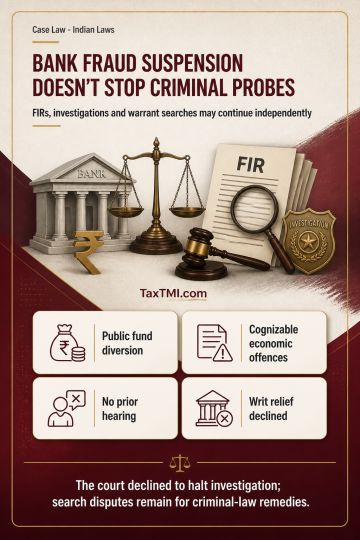
Administrative fraud classification suspension does not halt independent criminal investigation or warrant-based searches into alleged economic offenc...
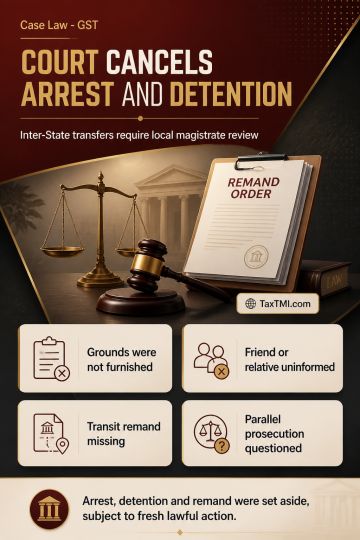
Arrest safeguards and transit remand requirements invalidated detention following inter-State transfer without communicated grounds or magistrate auth...
Arrest safeguards require disclosed grounds, relative intimation and transit remand, while duplicate prosecution under the CGST framework is unsustain...
Document Identification Number defects can invalidate GST assessments, with delayed challenges entertained conditionally where patent irregularities e...
The HC dismissed petitioners' challenge to investigation proceedings concerning large-scale tax evasion through fraudulent input tax credit under HPGST/CGST Act. The court held that Cr.P.C provisions apply to GST Act proceedings absent contrary provisions, citing Radhika Agarwal v. Union of India. Petitioners' contention that investigation was improper because officials failed to contact Delhi GST authorities was rejected. The court found that discovering non-existent entities at invoice addresses sufficiently established prima facie case of fake invoices. Following Mukesh Singh precedent, the court ruled investigation validity is not vitiated merely because departmental officials conducted it. The HC emphasized that while exercising inherent power, courts examine prima facie cases without evaluating evidence creditworthiness, which remains trial court's domain. Consequently, the complaint could not be quashed based on alleged investigative deficiencies.
The HC dismissed petitioners' challenge to investigation proceedings concerning large-scale tax evasion through fraudulent input tax credit under HPGST/CGST Act. The court held that Cr.P.C provisions apply to GST Act proceedings absent contrary provisions, citing Radhika Agarwal v. Union of India. Petitioners' contention that investigation was improper because officials failed to contact Delhi GST authorities was rejected. The court found that discovering non-existent entities at invoice addresses sufficiently established prima facie case of fake invoices. Following Mukesh Singh precedent, the court ruled investigation validity is not vitiated merely because departmental officials conducted it. The HC emphasized that while exercising inherent power, courts examine prima facie cases without evaluating evidence creditworthiness, which remains trial court's domain. Consequently, the complaint could not be quashed based on alleged investigative deficiencies.
Note: It is a system-generated summary and is for quick reference only.
 TaxTMI
 of 4803









 Join Channel


 TaxTMI
