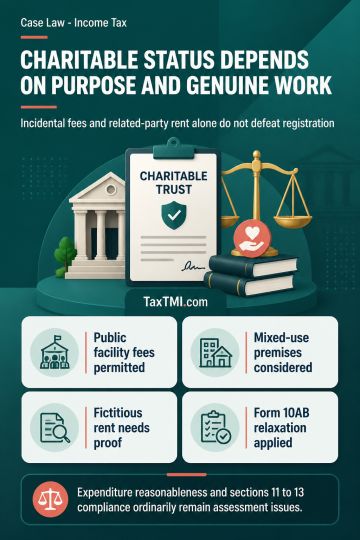
Charitable registration turns on predominant purpose and genuine activities, while incidental fees and related-party rent require supporting adverse m...
MAT book-profit adjustments exclude disallowances for exempt-income expenditure and demerger expenditure unless expressly listed under the statutory c...
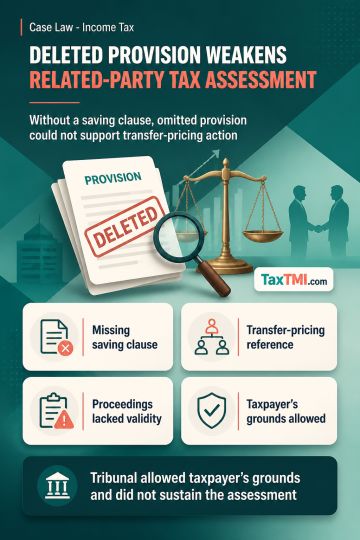
Omitted specified domestic transaction provision invalidates related-party expenditure transfer-pricing references and assessments based on consequent...
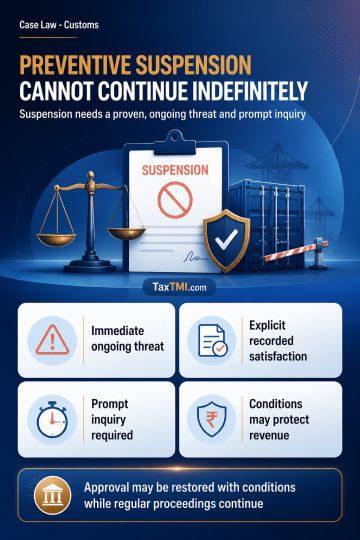
Preventive suspension requires an immediate continuing threat and cannot become indefinite without inquiry, fresh evidence, or proportionate safeguard...
Page of 4800
Press 'Enter' after typing page number.
261 to 280 of 96000 Results
❮
❯
❯❯
0 / 200
Expand Note
Add to Folder
No Folders have been created
+
Are you sure you want to delete "My most important" ?
The HC dismissed petitioners' challenge to investigation proceedings concerning large-scale tax evasion through fraudulent input tax credit under HPGST/CGST Act. The court held that Cr.P.C provisions apply to GST Act proceedings absent contrary provisions, citing Radhika Agarwal v. Union of India. Petitioners' contention that investigation was improper because officials failed to contact Delhi GST authorities was rejected. The court found that discovering non-existent entities at invoice addresses sufficiently established prima facie case of fake invoices. Following Mukesh Singh precedent, the court ruled investigation validity is not vitiated merely because departmental officials conducted it. The HC emphasized that while exercising inherent power, courts examine prima facie cases without evaluating evidence creditworthiness, which remains trial court's domain. Consequently, the complaint could not be quashed based on alleged investigative deficiencies.
The HC dismissed petitioners' challenge to investigation proceedings concerning large-scale tax evasion through fraudulent input tax credit under HPGST/CGST Act. The court held that Cr.P.C provisions apply to GST Act proceedings absent contrary provisions, citing Radhika Agarwal v. Union of India. Petitioners' contention that investigation was improper because officials failed to contact Delhi GST authorities was rejected. The court found that discovering non-existent entities at invoice addresses sufficiently established prima facie case of fake invoices. Following Mukesh Singh precedent, the court ruled investigation validity is not vitiated merely because departmental officials conducted it. The HC emphasized that while exercising inherent power, courts examine prima facie cases without evaluating evidence creditworthiness, which remains trial court's domain. Consequently, the complaint could not be quashed based on alleged investigative deficiencies.
Note: It is a system-generated summary and is for quick reference only.
 TaxTMI
 of 4800








 Join Channel


 TaxTMI