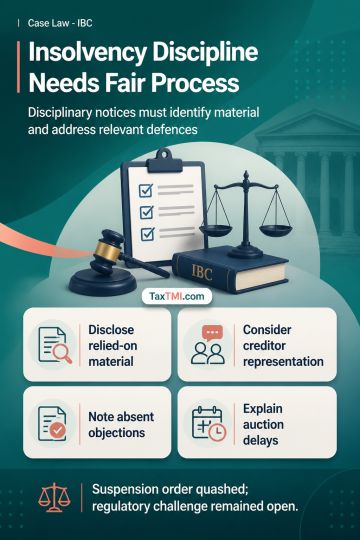
Natural justice in insolvency-professional discipline requires disclosed material; notices based on extraneous material and ignored defences are vitia...
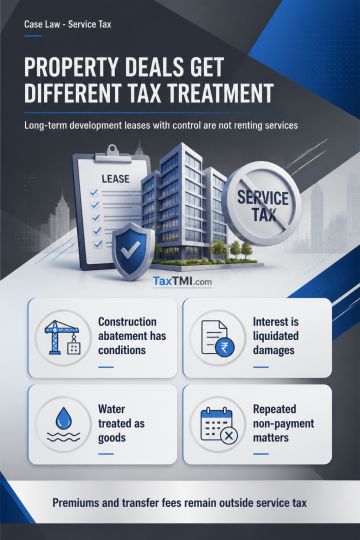
Development rights transfers treated as immovable property, while construction abatement applies and repeated non-payment permits extended service-tax...
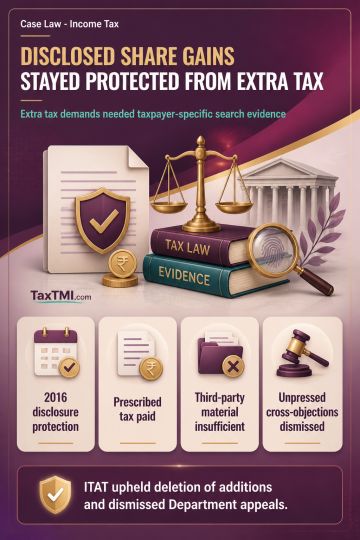
Income Disclosure Scheme immunity and search-material requirements barred further share-transaction additions in unabated assessments under section 15...
ITAT dismissed Revenue's appeal challenging deletion of protective additions made for alleged accommodation entries and unaccounted commission income. The tribunal confirmed that while protective assessments are permissible under established precedent when doubt exists regarding taxability in multiple hands, the specific circumstances warranted deletion. The corresponding substantive additions had been confirmed in the hands of directors and related persons, who were found to be the actual recipients. The appellants were determined to be mere name-lenders without independent taxable income. Applying the principle of avoiding double taxation, ITAT upheld CIT(A)'s decision to delete protective additions while maintaining substantive additions against the actual beneficiaries, thereby protecting Revenue interests without creating duplicative tax liability.
ITAT dismissed Revenue's appeal challenging deletion of protective additions made for alleged accommodation entries and unaccounted commission income. The tribunal confirmed that while protective assessments are permissible under established precedent when doubt exists regarding taxability in multiple hands, the specific circumstances warranted deletion. The corresponding substantive additions had been confirmed in the hands of directors and related persons, who were found to be the actual recipients. The appellants were determined to be mere name-lenders without independent taxable income. Applying the principle of avoiding double taxation, ITAT upheld CIT(A)'s decision to delete protective additions while maintaining substantive additions against the actual beneficiaries, thereby protecting Revenue interests without creating duplicative tax liability.
Note: It is a system-generated summary and is for quick reference only.
 TaxTMI
  TaxTMI
 of 4828







 Join Channel