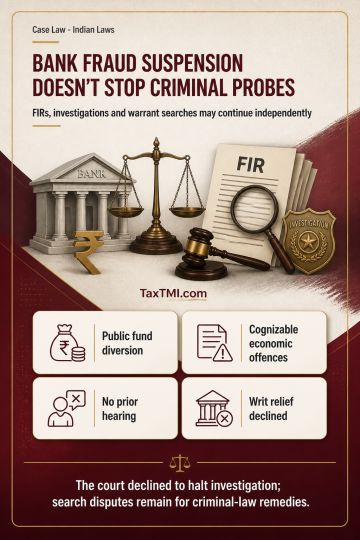
Administrative fraud classification suspension does not halt independent criminal investigation or warrant-based searches into alleged economic offenc...
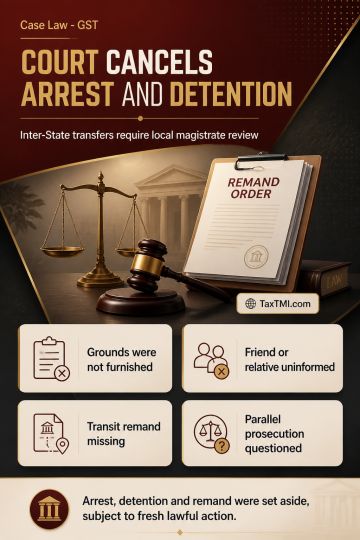
Arrest safeguards and transit remand requirements invalidated detention following inter-State transfer without communicated grounds or magistrate auth...
Arrest safeguards require disclosed grounds, relative intimation and transit remand, while duplicate prosecution under the CGST framework is unsustain...
Page of 4805
Press 'Enter' after typing page number.
821 to 840 of 96091 Results
❮
❯
❯❯
0 / 200
Expand Note
Add to Folder
No Folders have been created
+
Are you sure you want to delete "My most important" ?
The Delhi State Tax Department adopted CBIC Circular No. 236/30/2024-GST clarifying the scope of "as is/as is, where is basis" regularization in GST matters. The circular, issued under Section 168 of CGST Act 2017 following GST Council's 54th meeting recommendation, addresses field formation doubts regarding tax regularization where competing rates existed. The clarification establishes that regularization applies when genuine interpretational doubts arose between different GST rates, allowing taxpayers who paid lower rates to treat such payments as full discharge of liability without additional payment obligations. However, those who paid higher rates receive no refunds, and regularization excludes cases where no tax was paid at all. The circular provides three illustrations demonstrating application scenarios involving rate differentials of 5%, 12%, and nil rates, emphasizing that regularization only validates actual payments made at declared rates in filed returns, not non-payment situations.
The Delhi State Tax Department adopted CBIC Circular No. 236/30/2024-GST clarifying the scope of "as is/as is, where is basis" regularization in GST matters. The circular, issued under Section 168 of CGST Act 2017 following GST Council's 54th meeting recommendation, addresses field formation doubts regarding tax regularization where competing rates existed. The clarification establishes that regularization applies when genuine interpretational doubts arose between different GST rates, allowing taxpayers who paid lower rates to treat such payments as full discharge of liability without additional payment obligations. However, those who paid higher rates receive no refunds, and regularization excludes cases where no tax was paid at all. The circular provides three illustrations demonstrating application scenarios involving rate differentials of 5%, 12%, and nil rates, emphasizing that regularization only validates actual payments made at declared rates in filed returns, not non-payment situations.
Note: It is a system-generated summary and is for quick reference only.
 TaxTMI
 of 4805






 Join Channel


 TaxTMI

