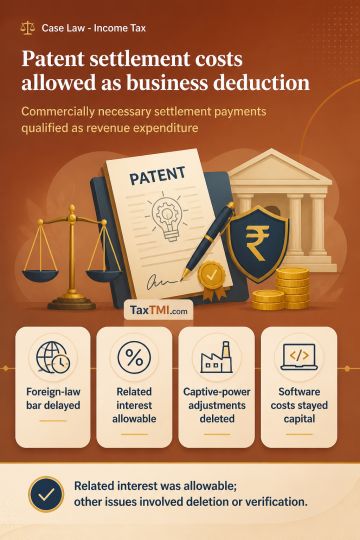
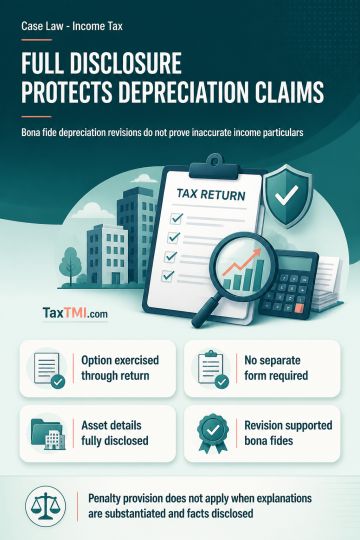
Patent-settlement expenditure treated as commercially expedient revenue outlay, with foreign-law restrictions inapplicable before the prospective amen...
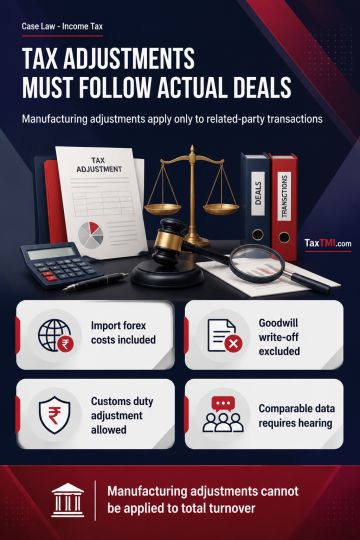
International transaction benchmarking restricts transfer pricing adjustments to associated-enterprise dealings, while functional comparability govern...
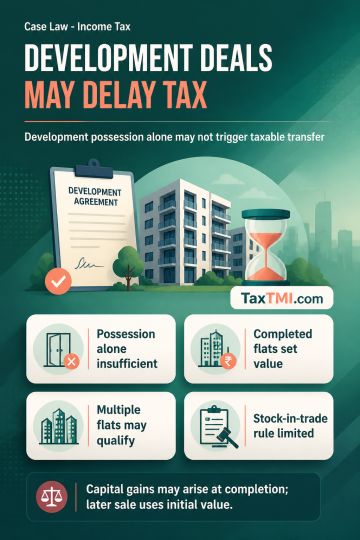
Joint development agreements defer taxable transfer where possession lacks part performance, while completed flats determine consideration and exempti...
Passenger baggage re-export requires true declaration and cannot be granted indirectly through discretionary redemption of undeclared prohibited goods...
Page of 4803
Press 'Enter' after typing page number.
501 to 520 of 96046 Results
❮
❯
❯❯
0 / 200
Expand Note
Add to Folder
No Folders have been created
+
Are you sure you want to delete "My most important" ?
The Delhi State Tax Department adopted CBIC Circular No. 236/30/2024-GST clarifying the scope of "as is/as is, where is basis" regularization in GST matters. The circular, issued under Section 168 of CGST Act 2017 following GST Council's 54th meeting recommendation, addresses field formation doubts regarding tax regularization where competing rates existed. The clarification establishes that regularization applies when genuine interpretational doubts arose between different GST rates, allowing taxpayers who paid lower rates to treat such payments as full discharge of liability without additional payment obligations. However, those who paid higher rates receive no refunds, and regularization excludes cases where no tax was paid at all. The circular provides three illustrations demonstrating application scenarios involving rate differentials of 5%, 12%, and nil rates, emphasizing that regularization only validates actual payments made at declared rates in filed returns, not non-payment situations.
The Delhi State Tax Department adopted CBIC Circular No. 236/30/2024-GST clarifying the scope of "as is/as is, where is basis" regularization in GST matters. The circular, issued under Section 168 of CGST Act 2017 following GST Council's 54th meeting recommendation, addresses field formation doubts regarding tax regularization where competing rates existed. The clarification establishes that regularization applies when genuine interpretational doubts arose between different GST rates, allowing taxpayers who paid lower rates to treat such payments as full discharge of liability without additional payment obligations. However, those who paid higher rates receive no refunds, and regularization excludes cases where no tax was paid at all. The circular provides three illustrations demonstrating application scenarios involving rate differentials of 5%, 12%, and nil rates, emphasizing that regularization only validates actual payments made at declared rates in filed returns, not non-payment situations.
Note: It is a system-generated summary and is for quick reference only.
 TaxTMI
 of 4803





 Join Channel


 TaxTMI