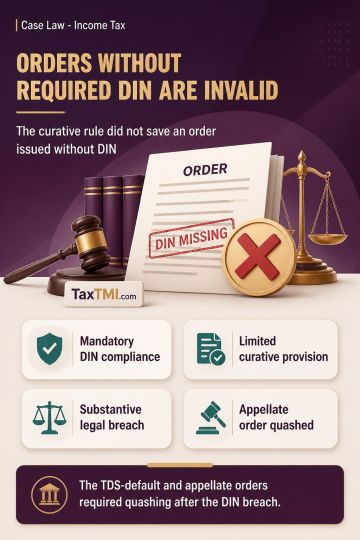
Document Identification Number compliance renders TDS-default orders invalid where mandatory DIN requirements are breached and curative provision does...
ITAT held that pre-operating expenses claimed by assessee as revenue expenditure were correctly disallowed. Tribunal established that mere nomenclature in books cannot determine expense allowability, applying precedents from India Discount Co. Ltd., Provincial Farmers Ltd., and KCP Ltd. Evidence demonstrated payments related to business expansion into new geographical areas before commercial exploitation, constituting capital expenditure. Regarding customer acquisition costs, ITAT sustained CIT(A)'s decision allowing 50% expenditure, recognizing revenue nature while applying amortization principle. Tribunal rejected assessee's argument for full deduction in current assessment year, upholding partial allowance approach for expenses benefiting future years despite assessee's non-election of amortization treatment.
ITAT held that pre-operating expenses claimed by assessee as revenue expenditure were correctly disallowed. Tribunal established that mere nomenclature in books cannot determine expense allowability, applying precedents from India Discount Co. Ltd., Provincial Farmers Ltd., and KCP Ltd. Evidence demonstrated payments related to business expansion into new geographical areas before commercial exploitation, constituting capital expenditure. Regarding customer acquisition costs, ITAT sustained CIT(A)'s decision allowing 50% expenditure, recognizing revenue nature while applying amortization principle. Tribunal rejected assessee's argument for full deduction in current assessment year, upholding partial allowance approach for expenses benefiting future years despite assessee's non-election of amortization treatment.
Note: It is a system-generated summary and is for quick reference only.
 TaxTMI
  TaxTMI
 of 4918