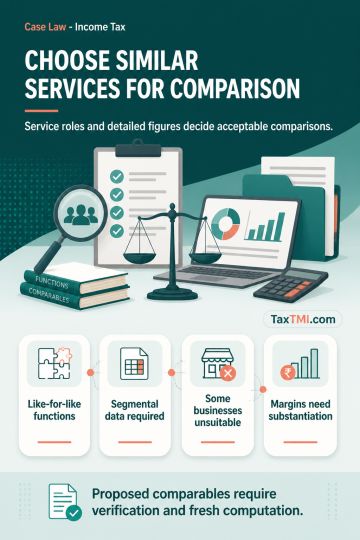
Functional comparability governs selection of support-service and IT-enabled service comparables, with verification required for unresolved data and m...
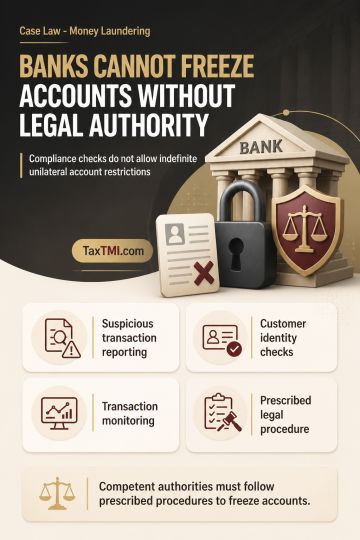
Bank account freezing requires statutory authority; anti-money-laundering compliance and KYC monitoring do not permit unilateral indefinite restrictio...
CESTAT held that payments termed as Overriding Commission to insurance agents constituted Insurance Auxiliary Services rather than Business Auxiliary Services under the Finance Act, 1994. The appellant was liable for service tax under Reverse Charge Mechanism on such payments. CENVAT credit availed on self-generated and forged invoices was inadmissible under CCR, 2004, as Rule 9 requires credit only on invoices issued by input service providers. The tribunal found deliberate misclassification and tax evasion through forged documentation. Service tax demand, interest, and penalty were justified due to irregularities and suppression of material facts. The burden of proof for credit admissibility lies with the service recipient, which the appellant failed to discharge. Despite these findings, the appeal was allowed.
CESTAT held that payments termed as Overriding Commission to insurance agents constituted Insurance Auxiliary Services rather than Business Auxiliary Services under the Finance Act, 1994. The appellant was liable for service tax under Reverse Charge Mechanism on such payments. CENVAT credit availed on self-generated and forged invoices was inadmissible under CCR, 2004, as Rule 9 requires credit only on invoices issued by input service providers. The tribunal found deliberate misclassification and tax evasion through forged documentation. Service tax demand, interest, and penalty were justified due to irregularities and suppression of material facts. The burden of proof for credit admissibility lies with the service recipient, which the appellant failed to discharge. Despite these findings, the appeal was allowed.
Note: It is a system-generated summary and is for quick reference only.
 TaxTMI
  TaxTMI
 of 4828





 Join Channel