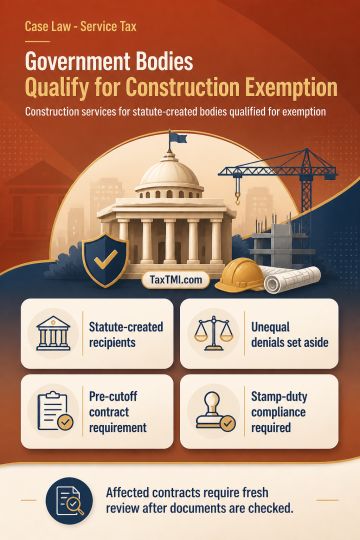
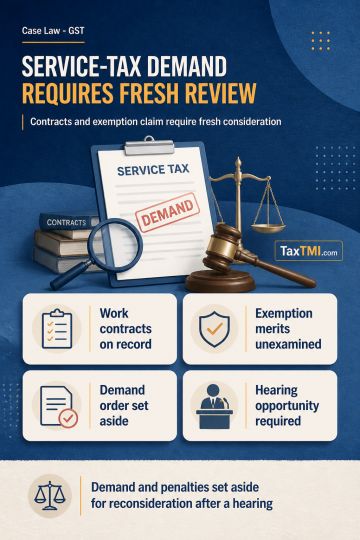
Governmental authority status supports construction-service exemption, while pre-cutoff contract and stamp-duty compliance requires verification on re...
Automated Free Sale and Commerce Certificates enable paperless processing while retaining risk-based manual verification for selected exporter applica...
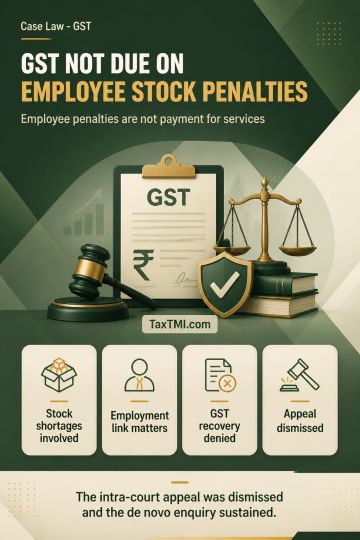
Employee stock-shortage penalties do not constitute consideration for services, preventing GST collection under Schedule II in employment relationship...
SC interprets Sections 29(1) and 29(1A) of the Competition Act, 2002, clarifying the discretionary powers of the Competition Commission. The Court distinguishes between the mandatory nature of "shall" in Section 29(1) and the discretionary "may" in Section 29(1A), emphasizing the Commission's expert discretion in determining whether to initiate a detailed investigation after issuing a show cause notice. The judgment reaffirms that the Commission retains flexibility in deciding the investigative process, rejecting a rigid two-phase mechanism. The review petition challenging the majority judgment's interpretation is ultimately allowed, with the Court providing critical clarification on the statutory provisions' scope and application.
SC interprets Sections 29(1) and 29(1A) of the Competition Act, 2002, clarifying the discretionary powers of the Competition Commission. The Court distinguishes between the mandatory nature of "shall" in Section 29(1) and the discretionary "may" in Section 29(1A), emphasizing the Commission's expert discretion in determining whether to initiate a detailed investigation after issuing a show cause notice. The judgment reaffirms that the Commission retains flexibility in deciding the investigative process, rejecting a rigid two-phase mechanism. The review petition challenging the majority judgment's interpretation is ultimately allowed, with the Court providing critical clarification on the statutory provisions' scope and application.
Note: It is a system-generated summary and is for quick reference only.
 TaxTMI
  TaxTMI
 of 4828









 Join Channel


