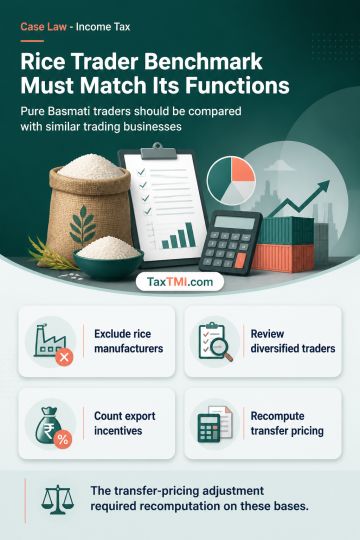
TNMM functional comparability requires excluding rice manufacturers from a pure Basmati rice trader's benchmark and recognising operating export recei...
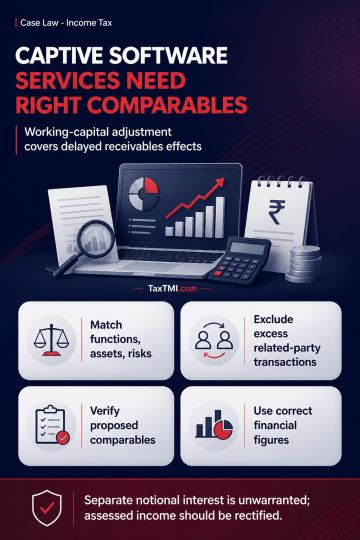
Working-capital adjustment subsumes delayed-receivable effects in TNMM benchmarking of captive software-development services, avoiding separate notion...
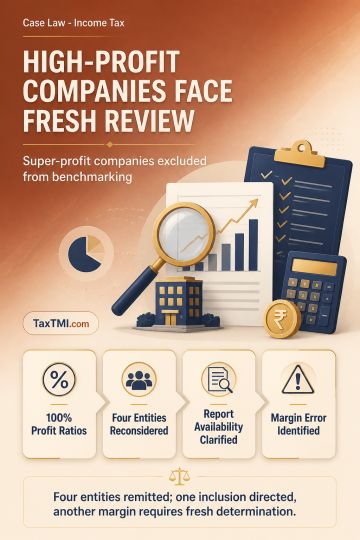
Transfer-pricing comparability requires exclusion of financially illogical super-profit comparables and correction of unsupported annual-report and ma...
Charitable character assessment preserves Section 80G approval despite inclusive spiritual teachings and incidental religious expenditure within the s...
Penalty proceedings for cash-loan acceptance require assessment proceedings and recorded Assessing Officer satisfaction; absent these, the proceedings...
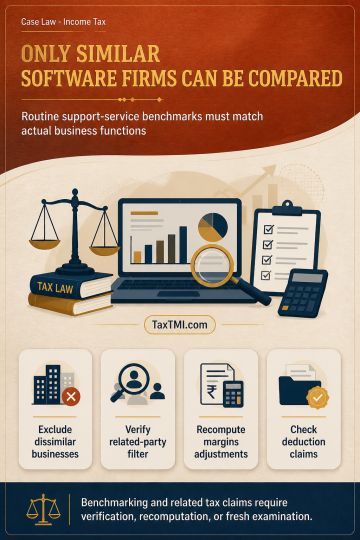
Functional comparability governs software-service benchmarking: dissimilar companies are excluded, while related-party filters, margins and working-ca...
SEBI issued a comprehensive framework for Environment, Social and Governance (ESG) Debt Securities, effective June 05, 2025. The circular establishes regulatory guidelines for issuance and listing of social bonds, sustainability bonds, and sustainability-linked bonds on recognized stock exchanges. Key provisions include mandatory initial and continuous disclosure requirements, appointment of independent third-party reviewers, and stringent measures to prevent purpose-washing. The framework aligns with international standards like ICMA Principles, Climate Bonds Standard, and aims to promote transparent and credible ESG debt securities issuance while protecting investor interests through robust regulatory oversight.
SEBI issued a comprehensive framework for Environment, Social and Governance (ESG) Debt Securities, effective June 05, 2025. The circular establishes regulatory guidelines for issuance and listing of social bonds, sustainability bonds, and sustainability-linked bonds on recognized stock exchanges. Key provisions include mandatory initial and continuous disclosure requirements, appointment of independent third-party reviewers, and stringent measures to prevent purpose-washing. The framework aligns with international standards like ICMA Principles, Climate Bonds Standard, and aims to promote transparent and credible ESG debt securities issuance while protecting investor interests through robust regulatory oversight.
Note: It is a system-generated summary and is for quick reference only.
 TaxTMI
  TaxTMI
 of 4830











 Join Channel


