Food supplement classification requires common parlance and authoritative tests, preventing treatment as proprietary Ayurvedic medicines without suppo...
Specified regulatory authority income receives conditional tax exemption, subject to non-commercial activity, unchanged income character, and return f...
Tax exemption for regulatory authority income applies retrospectively, subject to non-commercial activity, unchanged income sources, and return-filing...
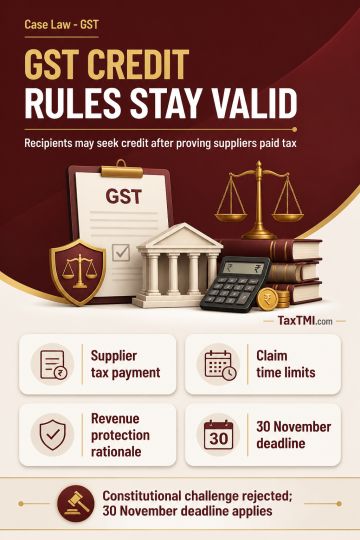
Input tax credit conditions remain constitutionally valid, with eligible recipient claims considered under GST circulars and retrospective filing dead...
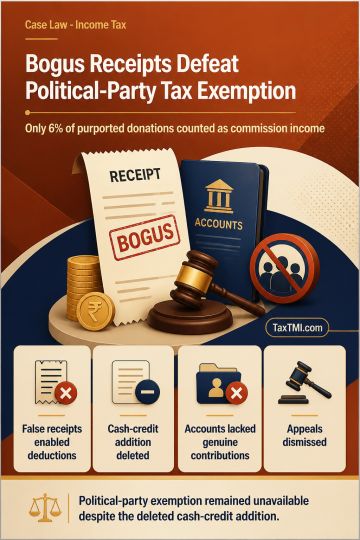
Bogus donation receipts justified commission income assessment and defeated political-party tax exemption for inaccurate accounts and reporting failur...
Legal Circular Analysis: The circular addresses key interpretative issues regarding Section 128A of the Assam GST Act, 2017, specifically clarifying two critical points. First, taxpayers who paid taxes through GSTR-3B before 1st November 2024 remain eligible for benefits under Section 128A, subject to proper officer verification. Second, for notices/orders spanning periods partially covered and outside Section 128A, taxpayers can file specific forms (SPL-01/SPL-02) after paying tax liabilities for covered periods, with appellate authorities empowered to adjudicate remaining periods independently. The guidance aims to provide procedural clarity and administrative flexibility in tax dispute resolution, ensuring uniform implementation across tax jurisdictions.
Legal Circular Analysis: The circular addresses key interpretative issues regarding Section 128A of the Assam GST Act, 2017, specifically clarifying two critical points. First, taxpayers who paid taxes through GSTR-3B before 1st November 2024 remain eligible for benefits under Section 128A, subject to proper officer verification. Second, for notices/orders spanning periods partially covered and outside Section 128A, taxpayers can file specific forms (SPL-01/SPL-02) after paying tax liabilities for covered periods, with appellate authorities empowered to adjudicate remaining periods independently. The guidance aims to provide procedural clarity and administrative flexibility in tax dispute resolution, ensuring uniform implementation across tax jurisdictions.
Note: It is a system-generated summary and is for quick reference only.
 TaxTMI
 of 4803














 Join Channel


 TaxTMI