GST refunds for cancelled air tickets remain available when passenger reimbursements defeat unjust enrichment and credit-note adjustment is unavailabl...
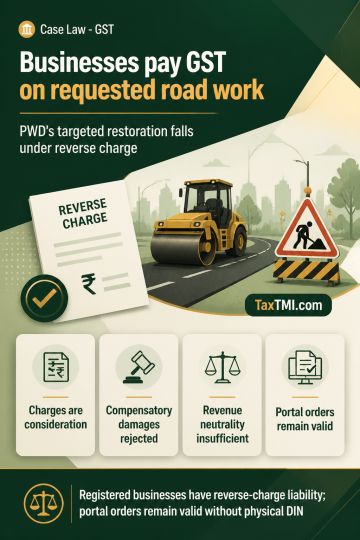
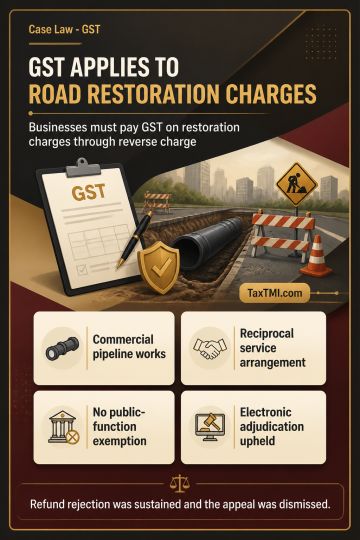
Request-driven road restoration attracts reverse-charge GST, not governmental-function treatment or compensatory-damages status for business recipient...
Road restoration charges for commercial pipeline works are taxable Government services, with reverse charge liability and no public-function exemption...
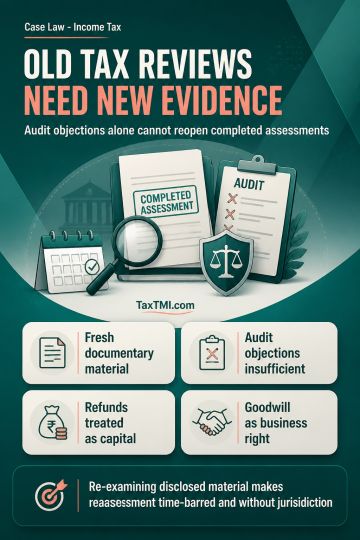
ITAT ruled on characterization of Focus Product/Market Scheme subsidy as capital receipt. The tribunal determined that the government subsidy aimed at enhancing export potential should be treated as capital receipt, excludable from book profit under Section 115JB. Relying on precedents from RSWM Ltd. and Nitin Spinners Ltd., the tribunal held that the subsidy constitutes a capital receipt in computing total income. Consequently, the assessee's claim was accepted, with Ground No. 1 decided in the taxpayer's favor, establishing the capital nature of the trade policy-related subsidy.
ITAT ruled on characterization of Focus Product/Market Scheme subsidy as capital receipt. The tribunal determined that the government subsidy aimed at enhancing export potential should be treated as capital receipt, excludable from book profit under Section 115JB. Relying on precedents from RSWM Ltd. and Nitin Spinners Ltd., the tribunal held that the subsidy constitutes a capital receipt in computing total income. Consequently, the assessee's claim was accepted, with Ground No. 1 decided in the taxpayer's favor, establishing the capital nature of the trade policy-related subsidy.
Note: It is a system-generated summary and is for quick reference only.
 TaxTMI
  TaxTMI
 of 4920