GST refunds for cancelled air tickets remain available when passenger reimbursements defeat unjust enrichment and credit-note adjustment is unavailabl...
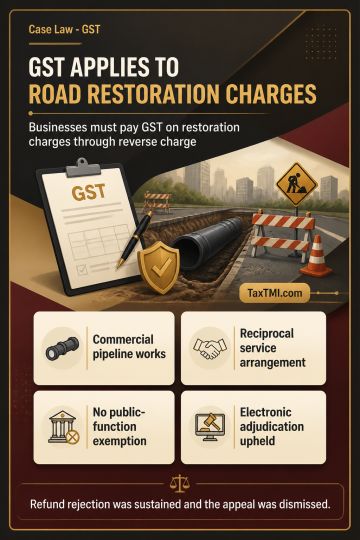
Request-driven road restoration attracts reverse-charge GST, not governmental-function treatment or compensatory-damages status for business recipient...
Road restoration charges for commercial pipeline works are taxable Government services, with reverse charge liability and no public-function exemption...
HC ruled that judicial discipline mandates strict adherence to appellate orders. The Assistant Commissioner's attempt to revisit a finalized order under Section 154 constitutes a gross impropriety and jurisdictional overreach. The court emphasized that lower judicial/quasi-judicial authorities must loyally accept decisions of higher appellate authorities to maintain systemic integrity. Refusing to implement unambiguous appellate judgments undermines the hierarchical legal framework and risks creating administrative anarchy. The court affirmed the petitioner's right to challenge such unauthorized proceedings, highlighting the fundamental principle that once an order attains finality, subordinate authorities must implement it without deviation.
HC ruled that judicial discipline mandates strict adherence to appellate orders. The Assistant Commissioner's attempt to revisit a finalized order under Section 154 constitutes a gross impropriety and jurisdictional overreach. The court emphasized that lower judicial/quasi-judicial authorities must loyally accept decisions of higher appellate authorities to maintain systemic integrity. Refusing to implement unambiguous appellate judgments undermines the hierarchical legal framework and risks creating administrative anarchy. The court affirmed the petitioner's right to challenge such unauthorized proceedings, highlighting the fundamental principle that once an order attains finality, subordinate authorities must implement it without deviation.
Note: It is a system-generated summary and is for quick reference only.
 TaxTMI
  TaxTMI
 of 4920