Pure reimbursement without income element escapes tax withholding, while delayed withholding and unsupported provisions face deferred or renewed scrut...
Public benefit requirement defeats charitable registration where residents' association services are reciprocal, member-only facilities governed by mu...
Exempt-income expenditure disallowance is confined to investments that actually generated exempt income, while supported business expenses remain dedu...
Objective characteristics and principal use govern mining-tyre classification, while fresh advance ruling applications may rely on additional technica...
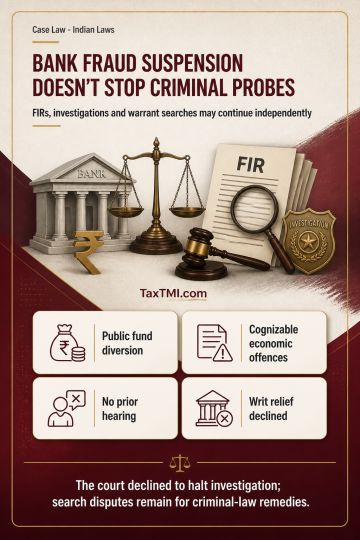
Administrative fraud classification suspension does not halt independent criminal investigation or warrant-based searches into alleged economic offenc...
Page of 4803
Press 'Enter' after typing page number.
761 to 780 of 96046 Results
❮
❯
❯❯
0 / 200
Expand Note
Add to Folder
No Folders have been created
+
Are you sure you want to delete "My most important" ?
ITAT upheld the PCIT's revisionary order u/s 263, rejecting the assessee's contentions. The Tribunal found no illegality in the revision proceedings, noting that the AO failed to properly apply mandatory provisions of section 115BBE for additions u/s 68 and erroneously initiated penalty proceedings u/s 271(1)(c) instead of 271AAC. The Tribunal determined that the PCIT was justified in exercising revisionary powers since the issues raised were not pending before the First Appellate Authority and materially impacted revenue interests. The assessee's appeal challenging the revisionary order was consequently dismissed, affirming the PCIT's order as legally sound and procedurally correct.
ITAT upheld the PCIT's revisionary order u/s 263, rejecting the assessee's contentions. The Tribunal found no illegality in the revision proceedings, noting that the AO failed to properly apply mandatory provisions of section 115BBE for additions u/s 68 and erroneously initiated penalty proceedings u/s 271(1)(c) instead of 271AAC. The Tribunal determined that the PCIT was justified in exercising revisionary powers since the issues raised were not pending before the First Appellate Authority and materially impacted revenue interests. The assessee's appeal challenging the revisionary order was consequently dismissed, affirming the PCIT's order as legally sound and procedurally correct.
Note: It is a system-generated summary and is for quick reference only.
 TaxTMI
 of 4803






















 Join Channel


 TaxTMI