Corporate guarantee valuation permits actual ascertainable commission while barring retroactive application and extended-period penalties for bona fid...
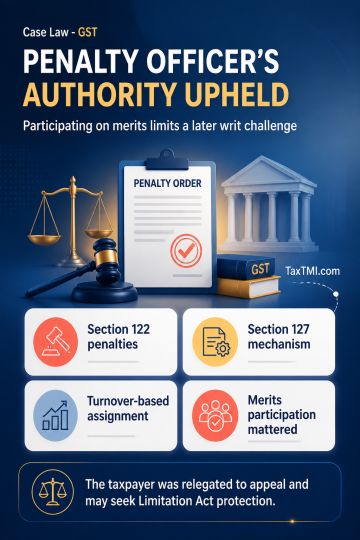
Proper-officer jurisdiction under UPGST penalty provisions upheld; participation on merits prevents bypassing the statutory appellate remedy through w...
Transitioned CENVAT credit may validly satisfy mandatory pre-deposit requirements for legacy service tax appeals through Electronic Credit Ledger debi...
Building-plan sanction charges require statutory authority; unauthorised fees and GST were quashed, while labour cess must follow prescribed collectio...
Pure-agent exclusion fails where hotel booking facilitators receive third-party services themselves, making entire customer consideration taxable as r...
Transfer pricing requires evidence for AMP transactions, functionally reliable comparables, and appropriate aggregation or Berry Ratio benchmarking me...
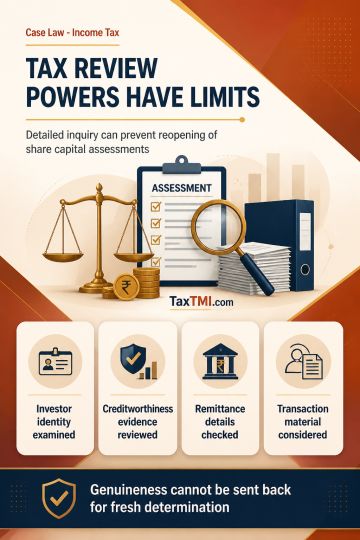
Revisionary jurisdiction cannot reopen share capital assessments where adequate inquiry supports a permissible view and no independent error is establ...
Page of 4794
Press 'Enter' after typing page number.
1 to 20 of 95872 Results
❮
❯
❯❯
0 / 200
Expand Note
Add to Folder
No Folders have been created
+
Are you sure you want to delete "My most important" ?
ITAT upheld the PCIT's revisionary order u/s 263, rejecting the assessee's contentions. The Tribunal found no illegality in the revision proceedings, noting that the AO failed to properly apply mandatory provisions of section 115BBE for additions u/s 68 and erroneously initiated penalty proceedings u/s 271(1)(c) instead of 271AAC. The Tribunal determined that the PCIT was justified in exercising revisionary powers since the issues raised were not pending before the First Appellate Authority and materially impacted revenue interests. The assessee's appeal challenging the revisionary order was consequently dismissed, affirming the PCIT's order as legally sound and procedurally correct.
ITAT upheld the PCIT's revisionary order u/s 263, rejecting the assessee's contentions. The Tribunal found no illegality in the revision proceedings, noting that the AO failed to properly apply mandatory provisions of section 115BBE for additions u/s 68 and erroneously initiated penalty proceedings u/s 271(1)(c) instead of 271AAC. The Tribunal determined that the PCIT was justified in exercising revisionary powers since the issues raised were not pending before the First Appellate Authority and materially impacted revenue interests. The assessee's appeal challenging the revisionary order was consequently dismissed, affirming the PCIT's order as legally sound and procedurally correct.
Note: It is a system-generated summary and is for quick reference only.
 TaxTMI




















 Join Channel


 TaxTMI